Big Tech AI Earnings Divergence: The ROI Reckoning Arrives
The dawn of 2026 has ushered in a brutal new phase for the Artificial Intelligence revolution: the “Show Me the Money” era. For years, investors poured trillions into Big Tech on the promise of future transformation. Now, following the pivotal Q4 2025 earnings season, Wall Street has drawn a sharp line in the sand. The result is a stark Big Tech AI earnings divergence that has reshuffled the leaderboard of the world’s most valuable companies.
No longer is “AI capital expenditure” a badge of honor on its own. The market is now ruthlessly distinguishing between companies that are turning massive infrastructure spend into immediate revenue acceleration and those that are merely burning cash while hitting physical and geopolitical walls.
The Tale of Two Titans: Meta vs. Microsoft
The most defining moment of this earnings cycle was the decoupling of fortunes between Meta Platforms and Microsoft. Both companies announced eye-watering capital expenditure (Capex) plans for 2026, yet their stock prices reacted in opposite directions.
Meta: Monetization Machines Firing on All Cylinders
Meta shocked analysts not with the scale of its spending—projected at a massive $115-$135 billion for 2026—but with the immediate, tangible returns it is already generating. The company reported a Q4 revenue surge of roughly 24%, driven largely by AI-optimized ad targeting that has revitalized its core business. Investors sent shares soaring over 10% because the narrative was clear: AI isn’t just a science project; it is the engine currently printing cash.
CEO Mark Zuckerberg’s strategy of integrating AI directly into user engagement algorithms has proven that massive compute spend can yield near-term margin expansion, quieting fears of a “profitless boom.”
Microsoft: The Capacity Ceiling
Conversely, Microsoft—once the undisputed leader of the AI trade—faced a harsh 11% sell-off. Despite promising demand, the company hit a wall. Azure’s growth slowed to just under 40%, a deceleration blamed not on a lack of customers, but on a lack of capacity. The company simply could not build data centers fast enough to meet demand, hindered by energy constraints and GPU supply bottlenecks.
This divergence in market reaction highlights a critical risk factor for 2026: Execution speed. It matters little if you have the best AI models if you cannot plug them into the grid.
The “Electron Gap”: A Geopolitical Stranglehold
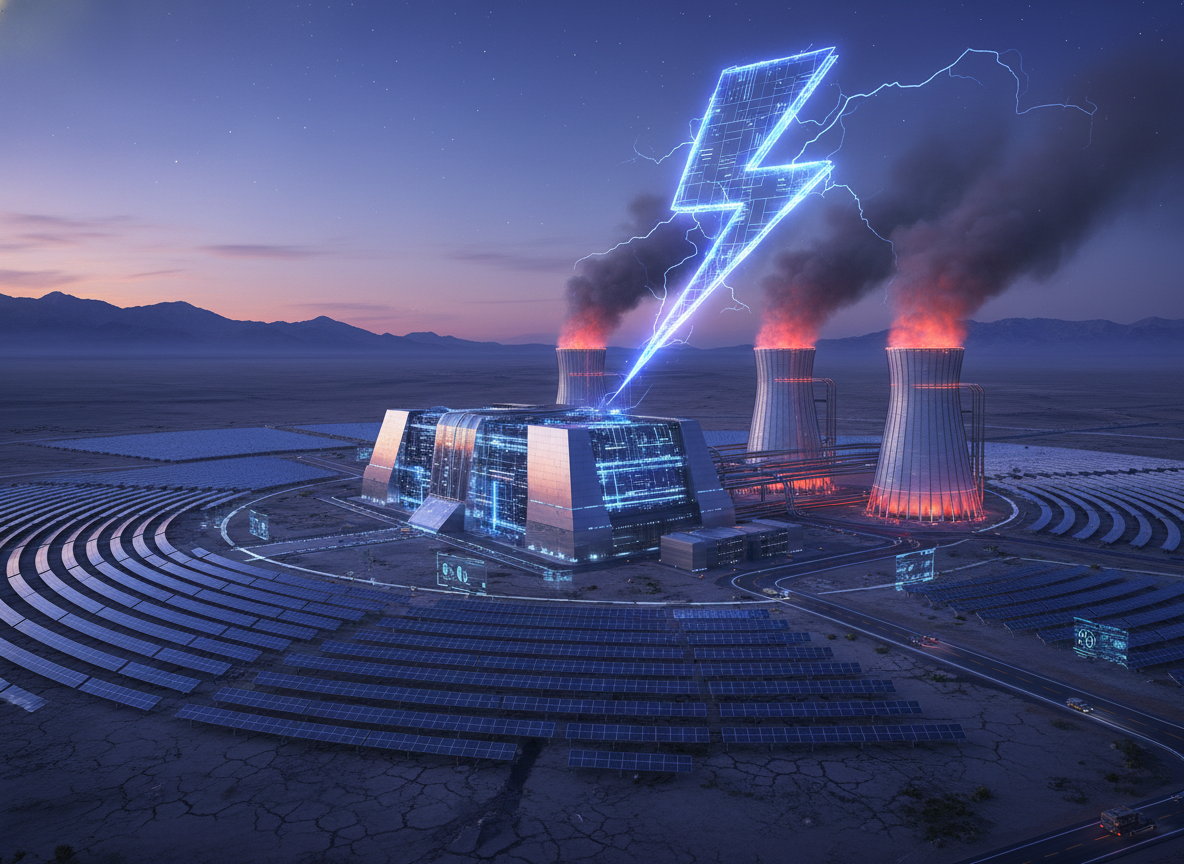
Beyond the balance sheets, a more insidious challenge emerged in Q4 2025: the widening “Electron Gap” between the U.S. and its geopolitical rivals. The Brookings Institution recently highlighted that while the U.S. retains a lead in semiconductor design, it is severely lagging in power generation capacity.
Power Wars
Data center energy demand in the U.S. is projected to double by 2030, yet the domestic grid is creaking under the strain. In contrast, China is bringing power capacity online at a rate nearly double that of the U.S., potentially allowing them to scale AI inference clusters faster despite chip sanctions. This reality is forcing U.S. Big Tech to get creative—and political.
- Amazon has begun touting its waste-heat recycling projects in Europe (like those in Dublin) as a geopolitical asset, helping energy-starved nations meet heating goals while hosting US-controlled data.
- Nuclear Options: Microsoft and Google are aggressively lobbying for small modular reactor (SMR) approvals, effectively turning tech companies into energy utilities.
The Rise of “Sovereign AI”
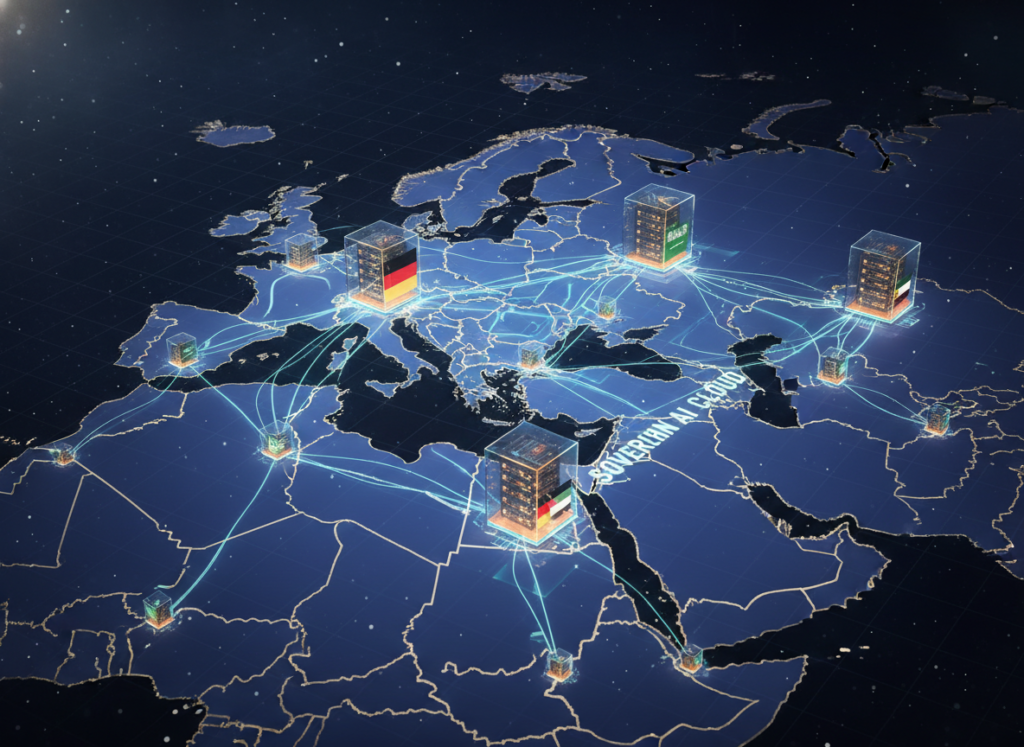
Another key theme driving the Big Tech AI earnings divergence is the fragmentation of the global cloud. Nations in the Middle East and Europe are no longer content to simply rent American compute; they want Sovereign AI—infrastructure located within their borders, governed by their laws.
This trend is creating a bifurcated market. Companies like Oracle and Google Cloud (which received a “Strong Buy” rating from analysts this quarter) are capitalizing on this by building “sovereign clouds” in regions like Saudi Arabia and Germany. These isolated clouds ensure data residency, allowing Big Tech to tap into massive state-backed investment funds despite tightening export controls.
According to recent reports from policy think tanks, the U.S. government is increasingly scrutinizing these deals, fearing that sensitive AI weights could leak to adversaries. This geopolitical tightrope walk adds a “complexity discount” to earnings for companies with heavy exposure to sensitive regions.
Capex Shock: The $500 Billion Bet
The collective capital expenditure for the “Hyperscalers” (Microsoft, Amazon, Alphabet, Meta) is now projected to exceed $500 billion in 2026. To put that in perspective, that is roughly the GDP of a mid-sized European nation, solely dedicated to servers, chips, and cooling systems.
This level of spending has spooked generalist investors who recall the dot-com crash. However, the divergence suggests the market is not rejecting the spending itself, but rather the opacity of the return on investment. Google’s clear communication about Gemini-driven cloud growth (accelerating to ~35%) helped it avoid Microsoft’s fate, proving that transparency is as valuable as profitability in this volatile environment.
The Semiconductor Squeeze
The earnings reports also highlighted the precarious position of chipmakers. While demand remains infinite, export controls are biting. The U.S. tightening of restrictions on high-end chips (like the Nvidia H200) to China has forced a reshuffling of supply chains. Revenue that would have come from Chinese hyperscalers is being backfilled by Sovereign AI projects in the UAE and Europe, but the friction costs are rising.
For a deeper dive into how these macroeconomic shifts affect your portfolio, financial analysis sites like Bloomberg Markets offer real-time tracking of these semiconductor trade flows.
Conclusion: The Great Separation
The “Big Tech AI Earnings Divergence” of early 2026 is not a temporary blip; it is the new normal. The rising tide no longer lifts all boats. We are entering a period of execution separation, where physical constraints (power, land) and geopolitical constraints (sovereignty, sanctions) will determine winners and losers as much as code quality.
For investors and business analysts, the lesson is clear: Stop looking at “AI” as a monolith. Start looking at the plumbing. Look for the companies that have secured the power, navigated the sovereignty traps, and—most importantly—proved they can turn a billion dollars of silicon into a billion dollars of ad revenue today, not tomorrow.