Agentic Commerce: The $5 Trillion Shift Redefining the Global Economy
The digital economy is standing on the precipice of a transformation so profound that industry analysts are comparing it to the advent of the mobile internet. This shift is known as Agentic Commerce. No longer confined to the realm of theoretical artificial intelligence, agentic commerce represents the next evolutionary stage of digital trade, moving beyond static storefronts and human-initiated searches to a dynamic ecosystem where AI agents autonomously negotiate, purchase, and transact on behalf of consumers and businesses.
As we navigate through 2026, the implications of this technology are becoming increasingly visible. Major financial institutions and tech giants are racing to build the infrastructure that will support a machine-to-machine economy. For business leaders and global investors, understanding the mechanics and economic potential of agentic commerce is no longer optional—it is a strategic imperative.
Defining Agentic Commerce in the Modern Era
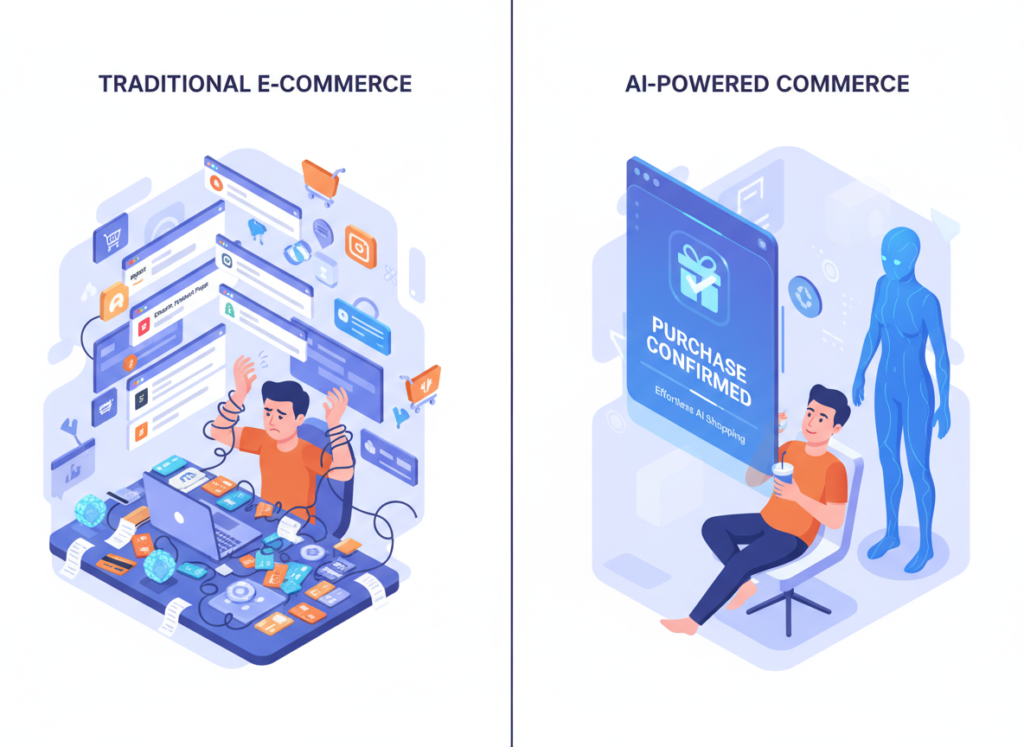
At its core, agentic commerce refers to the use of autonomous AI agents to execute commercial tasks. Unlike traditional e-commerce, which relies on a human user to browse, compare, and click “buy,” agentic commerce delegates these responsibilities to sophisticated software capable of reasoning, planning, and taking action.
These agents do not merely recommend products; they actively participate in the transaction lifecycle. They can analyze complex user intents—such as “plan a business trip to London under $3,000 with a preference for Star Alliance airlines”—and execute the necessary bookings, payments, and itinerary management without continuous human oversight. This transition marks a move from interaction-driven commerce to outcome-driven commerce.
According to a seminal report by McKinsey & Company, this shift is not just an incremental improvement but a fundamental rethinking of shopping itself. The firm projects that agentic commerce could orchestrate up to $5 trillion in global economic activity by 2030. This staggering figure underscores the speed at which this technology is expected to permeate both B2C and B2B sectors.
The Economic Mechanics of a Machine-to-Machine Economy
The introduction of autonomous agents into the global marketplace introduces new economic dynamics. In a traditional market, friction—such as search costs, limited information, and geographical barriers—often dictates pricing and liquidity. Agentic commerce systematically reduces these frictions, potentially leading to a more perfect market competition.
The Three Modes of Interaction
To understand the economic impact, one must first grasp the operational models currently taking shape:
- Agent-to-Site: A consumer’s AI agent interacts directly with a traditional e-commerce interface to retrieve information and execute purchases.
- Brokered Agent-to-Site: An intermediary platform routes requests between the user’s agent and various retailer sites, optimizing for price and availability.
- Agent-to-Agent (A2A): The most disruptive model, where a buyer’s AI agent negotiates directly with a seller’s AI agent. This allows for dynamic pricing, instant contract negotiation, and personalized inventory allocation in milliseconds.
This shift necessitates a massive overhaul of digital infrastructure. Retailers who previously optimized their websites for human eyeballs—focusing on visual appeal and psychological triggers—must now optimize for machine readability. Structured data, API accessibility, and real-time inventory fidelity are becoming the new currency of the digital shelf.
Key Players Driving the Infrastructure
The race to dominate the agentic commerce landscape is being led by a coalition of cloud giants, payment processors, and enterprise software leaders. These organizations are building the “rails” upon which autonomous agents will travel.
Salesforce and Enterprise Readiness
Salesforce has been at the forefront of this movement with its Agentforce initiative. By embedding autonomous agents into their Commerce Cloud, they are enabling retailers to deploy service and sales agents that can handle complex inquiries and transactions. Recent data from Salesforce indicates that traffic driven by AI assistants has grown by over 100% year-over-year, signaling a rapid consumer adoption of non-human interaction channels.
The Payment Revolution: Visa and Mastercard
One of the critical hurdles for agentic commerce is trust and authentication. How does a merchant know that an AI agent is authorized to spend a user’s money? To address this, global payment networks are rolling out new protocols. Visa and Mastercard are developing “agentic identity” standards that tokenize user authority, allowing agents to make secure payments within pre-set budget constraints. This financial layer is essential for moving agentic commerce from a novelty to a global economic engine.
Strategic Implications for Global Business
For the global economy, the rise of agentic commerce presents both opportunities and existential threats. The implications extend far beyond the retail sector, influencing logistics, supply chain management, and even macroeconomic forecasting.
Hyper-Personalization at Scale
In an agentic world, the concept of a “target audience” becomes granular to the level of the individual. Agents carry the context of a user’s entire preference history, allowing for hyper-personalized procurement. For B2B enterprises, this means procurement bots can dynamically source raw materials based on real-time pricing fluctuations and sustainability goals, optimizing supply chains with a precision previously unattainable.
The Risk of Commoditization
However, there is a stark risk for brands. AI agents are inherently rational. They prioritize data points like price, delivery speed, and specification matching over brand sentiment or marketing fluff. This could lead to a rapid commoditization of goods, where brand loyalty is eroded by algorithmic efficiency. Companies will need to find new ways to differentiate, perhaps by offering exclusive services or “human-verified” quality that agents are programmed to value.
Data Sovereignty and Privacy
As agents aggregate vast amounts of personal and corporate data to function effectively, data sovereignty becomes a critical issue. Governments worldwide are already scrutinizing the regulatory frameworks required to govern autonomous economic actors. The European Union and other regulatory bodies are exploring how GDPR and AI safety laws apply to agents that negotiate contracts and transfer funds autonomously.
Future Outlook: The Road to 2030
Looking ahead, the trajectory of agentic commerce points toward a fully integrated digital economy. By 2030, it is estimated that a significant percentage of all digital transactions will be initiated or completed by non-human actors. This evolution will likely spur the creation of “Agent Optimizations Strategies” (AOS), replacing traditional SEO. Businesses will vie to ensure their products and services are the top recommendation of the most popular AI assistants.
Furthermore, we can expect the emergence of specialized “Agent Marketplaces,” where consumers can rent highly specialized agents for specific tasks—such as a real estate negotiation agent or a high-frequency stock trading agent—democratizing access to sophisticated economic tools.
According to Forbes, the bottleneck for this transition is not the AI technology itself, which is advancing rapidly, but the readiness of sellers to support agents at scale. The businesses that invest today in machine-readable catalogs and API-first architectures will be the ones that thrive in the agentic era.
Agentic commerce is not merely a buzzword; it is the inevitable trajectory of a digital economy maturing into the age of artificial intelligence. By shifting the burden of transaction from human to machine, we are unlocking trillions of dollars in efficiency and creating a market that operates with unprecedented speed and precision. For global businesses, the message is clear: the agents are coming, and the economy is changing with them. Adaptation is the only path to relevance in this new autonomous frontier.