
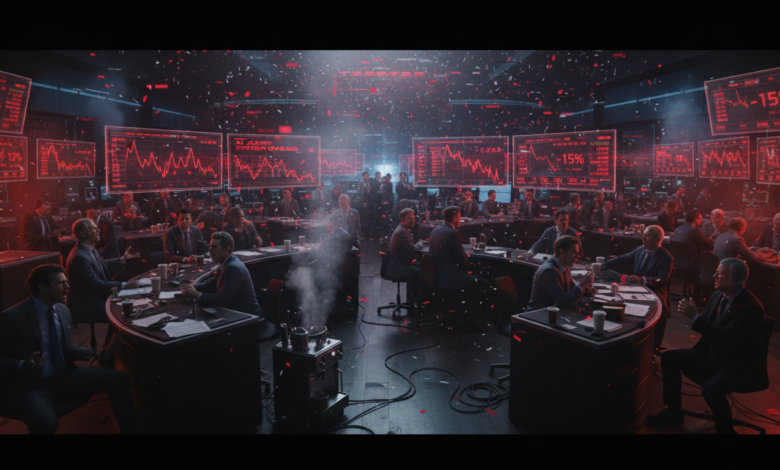
Wall Street is facing a new kind of panic. It is not about interest rates or oil prices this time. The market is currently gripped by an AI displacement sell-off, a sharp downturn driven by the realization that artificial intelligence might cannibalize revenue models faster than previously anticipated. Major players in the software and financial sectors, including legacy titans like IBM and American Express, are seeing their stock prices plummet as investors price in a future where human headcount—and the software licenses attached to them—drastically shrinks.
The narrative has shifted from AI as a productivity booster to AI as a revenue destroyer. Traders are reacting to reports of advanced coding agents and autonomous financial tools that threaten to make vast swaths of white-collar work obsolete. This fear of massive unemployment and the subsequent collapse of seat-based SaaS pricing models has triggered a volatility spike rarely seen in the tech sector.
The Spark Behind the AI Displacement Sell-Off
The catalyst for this market correction appears to be a convergence of new product releases and sobering economic data. Investors were already on edge following reports that the Dow sank on tariff uncertainty and AI fears, but the sell-off accelerated when specific capabilities of next-generation coding bots were demonstrated. These tools can now manage entire software lifecycles without human intervention.
For decades, the software industry relied on selling licenses based on the number of human users. If an AI agent can do the work of ten developers, companies will purchase fewer seats. This realization is the core driver of the AI displacement sell-off. It forces a complete re-evaluation of terminal value for companies that depend on large human workforces to consume their products.
Market analysts note that this is not just a tech story; it is a labor market story. The implications of AI disruption on jobs and the economy are moving from theoretical white papers to real-time stock valuations. When the market believes fewer humans will be employed, it bets against the companies that serve those humans.
Software Sector Under Siege
The software sector is bearing the brunt of the damage. Companies that provide developer tools, project management platforms, and communication suites are seeing heavy selling pressure. If an engineering team shrinks from 100 people to 5 people and an army of AI agents, the revenue for collaboration tools collapses.
Legacy tech giant IBM dropped significantly in early trading. While IBM has pivoted heavily toward AI, the market fears its vast consulting arm could be decimated by automation. Why hire a consulting firm when an internal AI model can restructure your supply chain in seconds? This question is at the heart of the debate regarding AI hype versus the next big thing. The market is currently betting that the “next big thing” involves significantly less revenue for incumbents.
This trend is visible across the broader tech landscape. Cloud consumption may rise, but the high-margin application layer is facing an existential crisis. Investors are rotating out of SaaS (Software as a Service) and into pure infrastructure plays, causing a divergence that is dragging down major indices.
Financial Giants Face Automation Anxiety
It is not just tech companies feeling the heat. Financial services firms like American Express and various regional banks are caught in the downdraft. The financial sector relies heavily on back-office processing, customer service, and data entry—roles that are prime targets for the new wave of AI agents.
American Express shares stumbled as analysts downgraded the stock, citing risks to its corporate card business. If work is transformed to the point where corporate travel and mid-level management tiers are hollowed out by AI, spending on corporate accounts could dry up. The logic is brutal but straightforward: fewer employees mean fewer expense accounts.
This sector-wide anxiety is reflected in the broader markets. Traders are looking for safety, but traditional defensive stocks in finance no longer look safe if their operational models are being disrupted. The efficiency gains from AI are undeniable, but the transition period promises to be chaotic for stock prices.

The Unemployment Ripple Effect
The AI displacement sell-off is fundamentally a bet on rising unemployment. If software writes itself and finances manage themselves, consumer spending power comes into question. A shrinking middle class translates to lower earnings for retailers, automakers, and homebuilders. This macroeconomic fear is why the sell-off is spreading beyond specific tech names.
Economic indicators are starting to flash warning signs. While inflation has been the primary worry for years, deflation driven by wage suppression is the new boogeyman. The economy operates on circulation; if AI hoards productivity gains without distributing wages, the velocity of money slows down.
According to a report by the Bureau of Labor Statistics, workforce participation in administrative roles has already begun to soften, lending credence to these fears. Wall Street hates uncertainty, and the inability to model future consumer demand in an AI-dominated world is causing a flight to cash.
Market Sentiment and Global Context
Global factors are compounding the domestic tech rout. The interaction between trade policies and tech disruption creates a volatile mix. Recent reports on the global market reaction to tariffs suggest that international revenue streams for US tech companies are also at risk. When you combine trade barriers with an internal crisis of business model viability, the result is a perfect storm for a sell-off.
Investors seeking insights before the market opens have been tracking these trends in Before the Bell newsletters, which have highlighted the growing correlation between AI advancements and stock volatility. The consensus is shifting from “AI will help everyone” to “AI will pick winners and destroy losers.”
For a broader perspective on how financial systems adapt to such shocks, data from the International Monetary Fund (IMF) suggests that rapid technological shifts often precede periods of significant market restructuring. We are likely in the early innings of this restructuring.
What This Means for Investors
Navigating an AI displacement sell-off requires a steady hand. Panic selling is rarely a winning strategy, but blind holding is equally dangerous. Investors must scrutinize their portfolios for companies whose revenue is directly tied to “seat count” or human-hour billing. These are the most vulnerable assets.
Conversely, companies that own the proprietary data or the physical infrastructure powering AI may remain resilient. The energy sector, for instance, is seeing increased interest as AI data centers demand massive power, a trend covered in global energy challenge reports.
Some strategists recommend looking at the risk takers who are successfully pivoting their business models. Companies that move from selling tools to selling outcomes—guaranteeing results rather than selling software licenses—may survive the transition.
Key Takeaways
- The Shift: Markets are repricing software and finance stocks based on the threat of AI replacing human workers and reducing SaaS seat revenue.
- Vulnerable Sectors: IBM, American Express, and per-seat software licensing models are seeing significant downside.
- Economic Fear: The sell-off is driven by the anticipation of lower consumer spending due to potential white-collar unemployment.
- Strategic Pivot: Investors are moving away from labor-dependent revenue models toward infrastructure and outcome-based businesses.
Final Thoughts
The AI displacement sell-off serves as a wake-up call. The honeymoon phase of generative AI is over, and the market is now grappling with the hard math of disruption. While the technology promises a utopian future of abundance, the bridge to get there is paved with volatility for stocks in software and finance.
For more detailed analysis on market movements, reliable data from Bloomberg indicates that institutional rotation out of legacy tech is accelerating. Investors must remain vigilant, adapting their strategies to a world where human labor is no longer the primary driver of corporate value.