
The AI Giga-Cycle: Reshaping the Global Economy and Investment Landscape
The global economy is currently witnessing the genesis of a phenomenon that transcends typical market cycles. Termed the “AI Giga-Cycle,” this structural shift represents a fundamental transformation in how economic value is generated, captured, and distributed. Unlike previous technological waves that prioritized consumer software applications, the AI Giga-Cycle is defined by an unprecedented, capital-intensive build-out of physical infrastructure—specifically, the data centers, energy grids, and semiconductor supply chains required to power the next generation of artificial intelligence.
As we move through 2026, the distinction between a standard “boom” and this Giga-Cycle is becoming increasingly stark. This is not merely a speculative bubble fueled by hype; it is the industrialization of intelligence. Major financial institutions and global consultancies have begun to quantify this shift, projecting that the integration of generative AI could add trillions of dollars to the global GDP annually. For business leaders and investors, understanding the mechanics of this cycle is no longer optional—it is a prerequisite for navigating the next decade of the global economy.
Defining the AI Giga-Cycle: The Rise of the Compute Economy
The AI Giga-Cycle is characterized by the transition from a service-based digital economy to a “compute economy.” In this new paradigm, computational power is a primary factor of production, akin to labor and capital. The demand for “compute”—the raw processing power necessary to train and run Large Language Models (LLMs)—has outstripped supply, triggering a massive reallocation of capital toward hardware and infrastructure.
This cycle is distinct because of its sheer scale and hardware dependency. While the dot-com era was defined by lightweight software and network effects, the AI Giga-Cycle is heavy. It requires millions of specialized Graphics Processing Units (GPUs), advanced cooling systems, and gigawatts of reliable electricity. This physical reality creates a high barrier to entry and favors entities with the balance sheets to sustain massive capital expenditures (CapEx).
According to a seminal report by McKinsey & Company, generative AI’s impact on productivity could add the equivalent of $2.6 trillion to $4.4 trillion annually to the global economy. To put this in perspective, the upper bound of this estimate exceeds the entire 2021 GDP of the United Kingdom. This potential value creation is the engine driving the Giga-Cycle, justifying the immense upfront costs currently being borne by the world’s largest technology firms.
The Investment Landscape: CapEx and the Hyperscalers
The primary drivers of the AI Giga-Cycle are the “hyperscalers”—technological titans such as Microsoft, Google, Amazon, and Meta. These corporations are engaged in an arms race to secure AI supremacy, leading to CapEx projections that defy historical norms. The focus has shifted from expanding user bases to expanding “compute capacity.”
Unprecedented Capital Expenditures
Financial analysts have noted that the level of investment in AI infrastructure is approaching levels typically associated with nation-state industrial projects. In 2026 alone, the combined capital spending of major AI companies is expected to surge as they race to build the physical backbone of the digital future.
Recent analysis from Goldman Sachs Research suggests that AI companies may invest more than $500 billion in capital expenditures in 2026. This figure underscores the magnitude of the commitment to the AI Giga-Cycle. Investors are no longer rewarding companies solely for growth in software revenue; they are scrutinizing the ability to deploy capital efficiently into assets that will yield long-term technological dominance.
The Semiconductor Supply Chain
At the heart of this investment frenzy lies the semiconductor industry. The demand for advanced logic chips and high-bandwidth memory (HBM) has created a “supercycle” within the chip sector itself. Companies that manufacture the tools for chip fabrication, such as lithography machines and etching equipment, are seeing order backlogs stretch years into the future. This is a direct consequence of the AI Giga-Cycle: every dollar spent on AI software necessitates multiple dollars spent on the underlying hardware.
Infrastructure Constraints: The Energy Bottleneck
While capital is abundant, physics is not negotiable. The most significant headwind facing the AI Giga-Cycle is not financial, but physical: the availability of power. AI data centers are voracious consumers of electricity, with next-generation training clusters requiring hundreds of megawatts of continuous power.
The Gigawatt Challenge
We are approaching a “gigawatt ceiling” in key data center hubs. Utility companies in Northern Virginia, Silicon Valley, and Ireland are struggling to meet the surging load requests from hyperscalers. This has led to a geographic dispersion of the Giga-Cycle, with investment flowing into regions that have stranded power capacity or favorable regulatory environments for new energy generation.
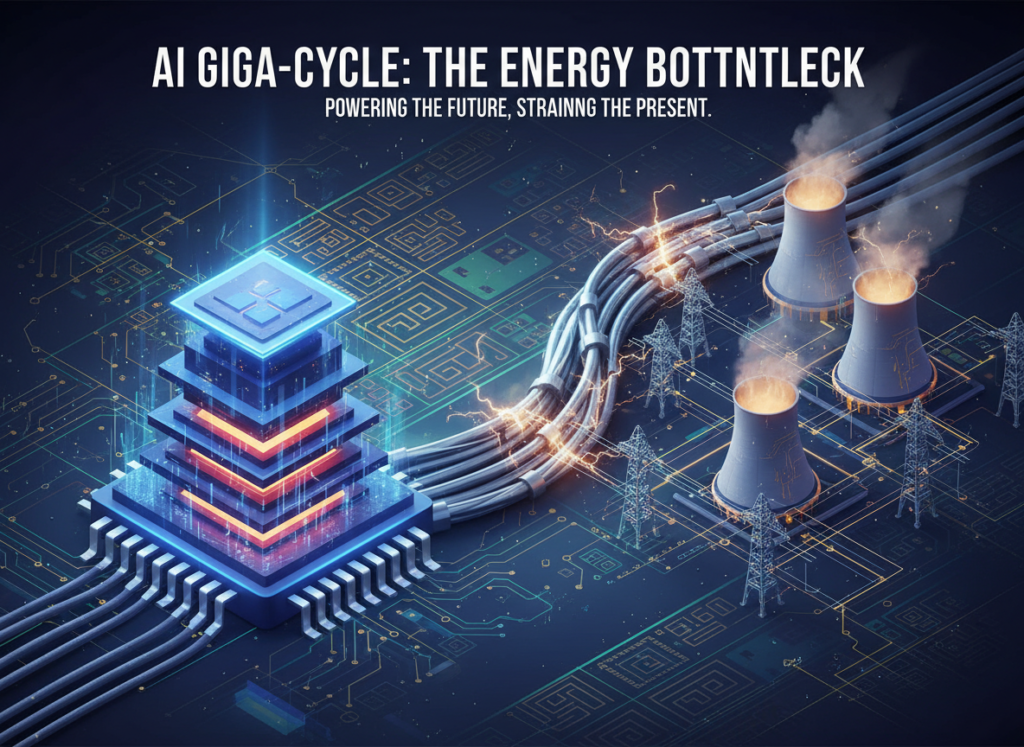
This dynamic is reshaping the energy sector. There is a growing convergence between big tech and nuclear power, as AI companies seek carbon-free, baseload power sources that can run 24/7. The economic implications are profound: energy infrastructure is now a critical component of the tech stack. Investors looking at the AI Giga-Cycle must broaden their scope to include utilities, grid modernization firms, and nuclear reactor developers.
Sovereign AI: Nations as Key Players
The AI Giga-Cycle has spilled over from the corporate boardroom to the geopolitical stage. Governments around the world have recognized that AI infrastructure is a matter of national security and economic sovereignty. This has gave rise to the concept of “Sovereign AI”—the idea that nations must own their own compute capacity and data models to avoid dependence on foreign tech giants.
Nations in the Middle East, Europe, and Asia are deploying sovereign wealth funds to purchase thousands of GPUs and build domestic data centers. This adds a new layer of demand to the Giga-Cycle, insulating it somewhat from purely commercial market fluctuations. When governments view compute as a strategic asset comparable to oil reserves, price sensitivity decreases, and long-term investment horizons prevail.
Market Projections and Long-Term Value
Forecasting the trajectory of the AI Giga-Cycle requires looking beyond immediate quarterly earnings. The consensus among market intelligence firms is that we are in the early stages of a decade-long expansion.
A report by Bloomberg Intelligence projects that the generative AI market is poised to explode, growing to $1.3 trillion by 2032. This growth will be driven by a compound annual growth rate (CAGR) of 42%, initially fueled by infrastructure spending before shifting toward software and services. This bifurcation—infrastructure first, applications second—is a classic hallmark of technological revolutions, mirroring the build-out of the railroads or the internet.
Risks and Challenges
Despite the optimistic projections, the AI Giga-Cycle is not without risks. The primary concern among skeptics is the timeline of monetization. While companies are spending hundreds of billions on hardware today, the revenue generating applications that justify this spend are still maturing. If the gap between CapEx and revenue becomes too wide or persists for too long, we could see a market correction or a “trough of disillusionment.”
Concentration Risk
The market is also grappling with extreme concentration. A handful of companies control the majority of the AI value chain, from chip design to cloud deployment. This creates systemic risk; a stumble by a key player like NVIDIA or a regulatory crackdown on a major hyperscaler could send shockwaves through the entire global economy.
The Talent Gap
Furthermore, the Giga-Cycle is constrained by human capital. There is a severe shortage of engineers capable of designing advanced chips, managing gigawatt-scale data centers, and training frontier models. This labor shortage drives up wages and operational costs, potentially impacting profit margins for firms lower down the value chain.
Navigating the Giga-Cycle
The AI Giga-Cycle is the defining economic narrative of our time. It is a multi-trillion-dollar re-platforming of the global economy that elevates “compute” to a critical resource status. For businesses, the imperative is to assess how this shift impacts their specific vertical—whether through disruption of their business model or through new efficiencies gained by adopting AI tools.
For investors, the Giga-Cycle offers opportunities beyond the obvious technology stocks. The ripple effects extend to energy, industrials, real estate (for data centers), and materials science. However, a disciplined approach is required. Distinguishing between companies that are building the actual rails of this new economy and those that are merely hitching a ride on the hype will be the key to generating sustainable returns.
As we look toward 2030 and beyond, the AI Giga-Cycle will likely be viewed as the moment the digital economy matured into a physical industrial force, fundamentally altering the global balance of economic power.