
Amazon’s $200B AI Gamble: A High-Stakes Bet on the Future of Cloud Computing
In a move that has simultaneously stunned Wall Street and signaled a new era in the technological arms race, Amazon.com Inc. has unveiled a staggering capital expenditure plan of approximately $200 billion for the fiscal year 2026. This announcement, made during the company’s recent fourth-quarter earnings call, represents one of the largest single-year infrastructure commitments in corporate history. As the tech giant pivots aggressively toward artificial intelligence, the sheer scale of this investment—dwarfing the GDP of many nations—raises a critical question: Is this a visionary masterstroke or a precarious gamble on unproven returns?
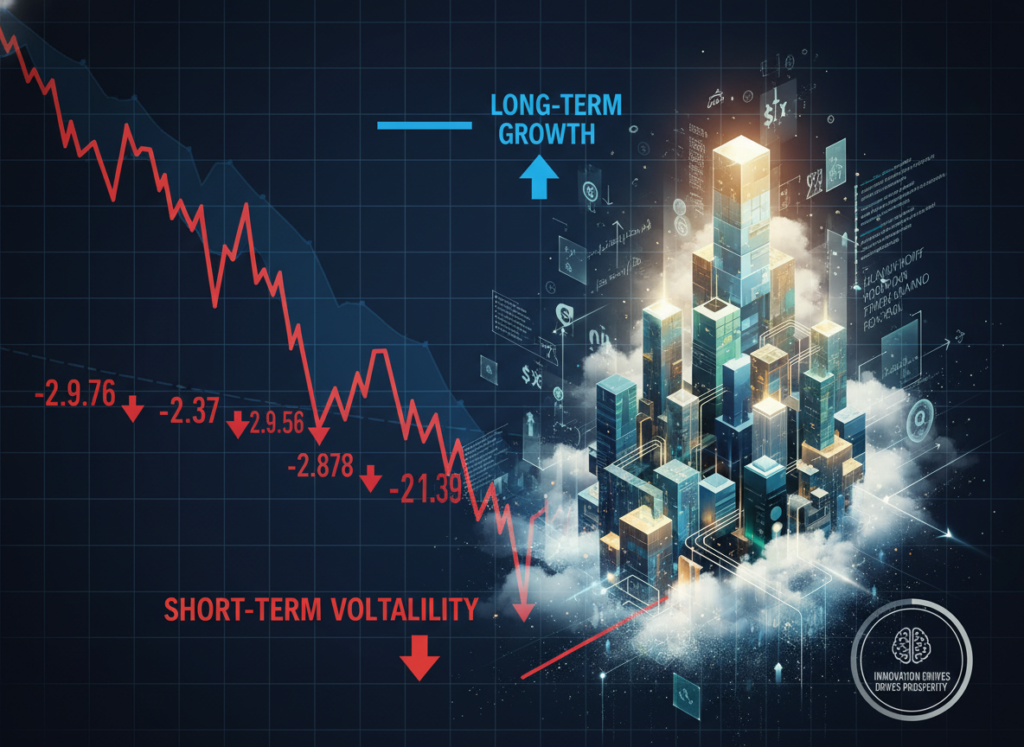
The disclosure immediately sent shockwaves through the market, with Amazon shares dipping over 10% in after-hours trading as investors digested the short-term profit implications of such massive spending. However, CEO Andy Jassy remains defiant, characterizing the expenditure not as reckless spending, but as a necessary evolution to capture a “seminal opportunity” in generative AI.
The Anatomy of a $200 Billion Bet
To understand the magnitude of Amazon’s gamble, one must dissect where this capital is flowing. Unlike previous investment cycles focused on fulfillment centers and logistics networks, the lion’s share of this $200 billion is earmarked for digital infrastructure. This includes a rapid expansion of data centers, energy procurement to power them, and the manufacturing of custom silicon chips.
According to financial reports analyzed by Bloomberg, Amazon’s spending outpaces its primary rivals, though not by a wide margin. Google’s parent company, Alphabet, recently projected its own capital expenditures to hit the $175 billion to $185 billion range for 2026. This escalation suggests a form of “Mutually Assured Construction,” where tech giants are compelled to build excess capacity to avoid being left behind in the AI revolution.
“We are monetizing capacity as fast as we can install it,” Jassy told investors, pushing back against the narrative that the spending is speculative. The demand, he argues, is real and immediate, driven by the explosive growth of Amazon Web Services (AWS), which saw revenue climb 24% year-over-year to $35.6 billion in the last quarter.
Silicon Independence: The Trainium & Inferentia Strategy
A significant portion of Amazon’s $200 billion war chest is dedicated to breaking the industry’s reliance on Nvidia GPUs. Amazon is doubling down on its proprietary AI chips: Trainium for model training and Inferentia for running those models.
The strategic logic here is twofold: cost control and supply chain sovereignty. By designing its own silicon, AWS can offer lower prices to customers—claiming up to 40% better price-performance than comparable instances—while insulating itself from the supply bottlenecks that have plagued the GPU market. As reported by The Wall Street Journal, the ability to control the full stack, from the data center cooling systems down to the transistor, is becoming the new competitive moat in cloud computing.
For enterprise clients, this promises a more sustainable cost structure for AI adoption. However, for Amazon, it requires billions in upfront R&D and fabrication costs before a single dollar of profit is realized from these chips.

The “Barbell” of AI Demand
During the earnings call, Jassy introduced a “barbell” analogy to describe the current state of the AI market. On one end are the research labs and foundation model builders—companies like Anthropic—consuming “gobs” of compute power to train the next generation of LLMs. On the other end are early-stage enterprise applications for routine tasks.
The $200 billion investment is targeted at the “middle of the barbell”: the anticipated wave of core enterprise production workloads. Amazon is betting that as companies move from experimenting with AI chatbots to integrating AI into mission-critical workflows, the demand for stable, secure, and scalable cloud infrastructure will explode. If this middle market fails to materialize as quickly as predicted, Amazon could be left with expensive, depreciating assets.
Investor Jitters vs. Long-Term Vision
The market’s negative reaction to the spending plan highlights a deepening tension between institutional investors and Big Tech leadership. Investors, accustomed to the fat margins of mature software businesses, are wary of the capital intensity required for AI. The Reuters financial desk noted that Amazon’s free cash flow, a key metric for shareholders, dropped to $11.2 billion in the face of these expenditures—a sharp decline from the previous year.
Yet, Amazon has played this game before. In the mid-2000s, critics questioned the company’s heavy spending to build AWS, which was then a niche service. Today, AWS is the profit engine of the entire company. Jassy’s defense of the 2026 budget echoes Jeff Bezos’s old mantra of prioritizing long-term leadership over short-term profitability.
The Energy Bottleneck
An often-overlooked component of the $200 billion figure is energy. AI data centers are voracious consumers of electricity. Amazon’s investment inevitably includes funding for renewable energy projects and potentially nuclear power agreements to ensure their grid can support millions of new GPUs and Trainium chips. This infrastructure layer adds complexity and regulatory risk to the gamble, as power availability becomes as critical as silicon availability.
Building the Future or Burning Cash?
Amazon’s $200 billion AI gamble is a defining moment for the tenure of Andy Jassy. If successful, it will cement AWS as the unassailable backbone of the AI economy, much as it became the backbone of the internet economy a decade ago. The proprietary chip strategy could yield margins that competitors reliant on Nvidia cannot match, and the massive capacity build-out will ensure no customer is turned away.
However, the risks are equally colossal. If the AI “bubble” deflates, or if enterprise adoption slows due to hallucination issues or regulatory hurdles, Amazon will be left holding the bill for the most expensive infrastructure project in corporate history. For now, Amazon is signaling that the risk of missing the AI wave is far greater than the risk of overspending on it.