

Amazon AI Restructuring 2026: The Strategic Pivot Redefining Tech
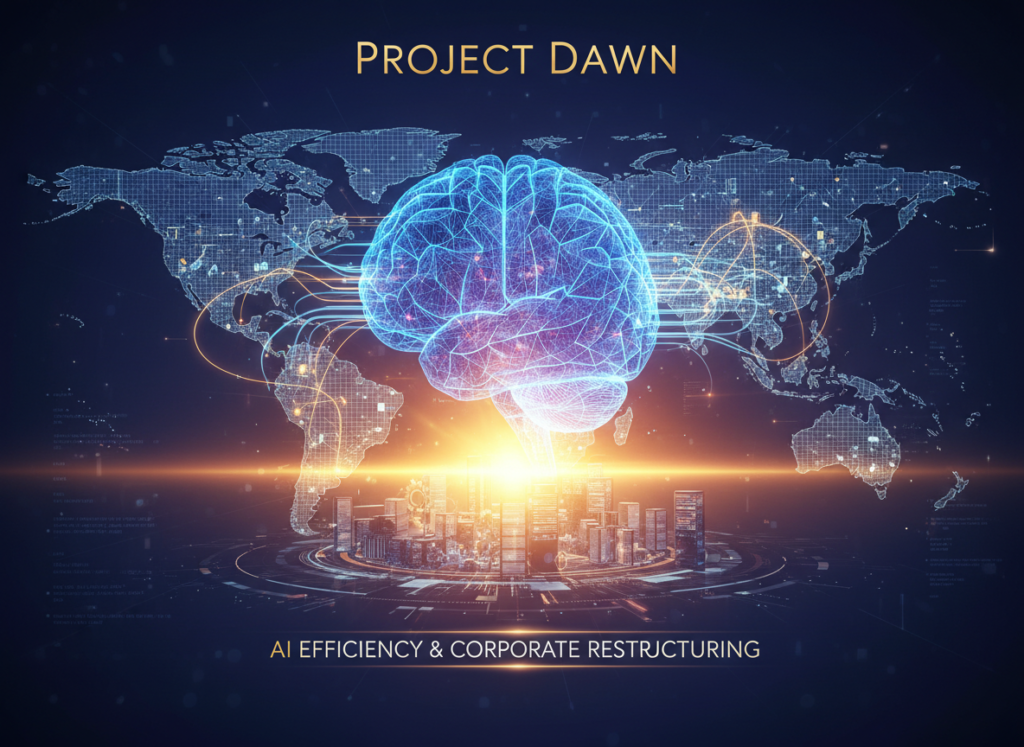
As the first quarter of 2026 unfolds, Amazon has initiated one of the most significant strategic pivots in its three-decade history. In a move that signals a decisive shift from e-commerce dominance to artificial intelligence supremacy, the tech giant has confirmed a fresh round of approximately 16,000 corporate layoffs. This restructuring, internally codenamed “Project Dawn,” is not merely a cost-cutting measure but a calculated reallocation of resources toward a future defined by Artificial General Intelligence (AGI) and automated efficiency.
For business leaders and investors, understanding the nuances of this transition is critical. It represents a broader economic trend where capital expenditure is increasingly decoupled from headcount growth—a phenomenon economists are beginning to call the “Great Divergence.” This article analyzes the drivers behind Amazon’s aggressive restructuring, the specifics of its $150 billion infrastructure bet, and the long-term implications for the global digital economy.
The “Project Dawn” Restructuring: Beyond Standard Layoffs
In late January 2026, leaks surrounding “Project Dawn” began to surface, culminating in an official memo from Beth Galetti, Amazon’s Senior Vice President of People Experience and Technology. The announcement confirmed the elimination of 16,000 corporate and technology roles, primarily affecting divisions within Amazon Web Services (AWS), Human Resources, and legacy retail operations. When combined with the 14,000 cuts announced in October 2025, the total reduction in Amazon’s white-collar workforce has reached nearly 30,000 in under six months.
Unlike the pandemic-era corrections of 2022 and 2023, these cuts are not driven by slowing demand. On the contrary, Amazon’s revenue streams remain robust. Instead, CEO Andy Jassy has framed this restructuring as a necessary evolution to “reduce bureaucracy” and “increase ownership.” However, the subtext is clear: the company is clearing the decks for an AI-first operational model.
Internal communications suggest that Amazon is aggressively flattening its organizational structure. The goal is to remove middle-management layers that slow down decision-making, allowing small, autonomous teams to deploy AI agents that can handle tasks previously requiring human oversight. This aligns with Jassy’s earlier warnings that generative AI would fundamentally change the equation of corporate headcount, allowing the company to do “more with less” on a scale previously unimaginable.
The $150 Billion Infrastructure Bet
While the headlines focus on workforce reductions, the financial story is one of unprecedented spending. Amazon has projected its capital expenditures (CapEx) to exceed $150 billion in 2026, a staggering figure dedicated almost entirely to AI infrastructure. This investment is fueling the expansion of data centers, the procurement of energy assets, and the mass deployment of custom silicon.
At the heart of this strategy is a move away from reliance on third-party GPU providers like NVIDIA. Amazon is doubling down on its proprietary chips—Trainium and Inferentia. By vertically integrating its AI hardware stack, Amazon aims to lower the cost of compute for its AWS customers, making it the default utility provider for the AI economy. This is a classic Amazon playbook: commoditize the infrastructure to squeeze competitors who rely on higher-margin, third-party hardware.
For more on the broader industry trends driving this infrastructure boom, Reuters Technology provides ongoing coverage of Big Tech’s capital expenditure wars.
De-coupling Revenue from Headcount
The economic implications of Amazon’s strategy are profound. For decades, tech growth was synonymous with hiring binges. “Project Dawn” signals the end of that era. Amazon is effectively betting that it can decouple revenue growth from headcount growth. By automating core coding, customer service, and logistical planning tasks with advanced AI models, the company strives to increase its operating margins significantly over the next decade.
This shift is creating anxiety across the tech sector, as software engineers and program managers—once considered “safe” roles—find themselves in the crosshairs of automation. The industry is watching closely: if Amazon succeeds in maintaining operational stability with 30,000 fewer corporate employees, other tech giants will likely follow suit, accelerating a sector-wide contraction in white-collar employment.
Product Frontiers: Project Metis and Olympus
The restructuring is also designed to free up resources for Amazon’s ambitious product roadmap. The company has been criticized for lagging behind OpenAI and Google in the generative AI race, a perception Jassy is determined to reverse. Two key initiatives have emerged from the restructuring efforts: Project Metis and the Olympus model.
- Project Metis: Acknowledging the limitations of earlier Alexa iterations, Metis is Amazon’s answer to ChatGPT. It is designed not just as a chatbot, but as an agentic system capable of executing complex workflows—from booking travel to managing smart home ecosystems—with a degree of autonomy that previous assistants lacked.
- Olympus: This is Amazon’s frontier foundation model. Unlike competitors that rely on public internet data, Olympus is reportedly trained on Amazon’s vast proprietary datasets, including AWS code repositories and retail purchasing data. This unique training data could give Olympus an edge in enterprise and commerce-related tasks, areas where generic models often struggle with hallucinations or lack of context.
These projects are being developed under a newly consolidated AGI team, reporting directly to top leadership. The removal of bureaucratic layers is intended to speed up the iteration cycles of these models, which are critical for AWS to retain its cloud dominance against Microsoft Azure.
The Global Economic Context
Amazon’s moves must be viewed through the lens of the global economy. As central banks navigate interest rate adjustments and inflation data, the “AI deflationary pressure” is becoming a real macroeconomic factor. By automating expensive human labor, companies like Amazon are technically driving down the cost of services, which could have long-term deflationary effects.
However, this transition comes with volatility. The Bloomberg Technology section frequently highlights the tension between tech efficiency and labor market stability. As Amazon pivots, it forces the entire supply chain—from logistics partners to cloud clients—to adapt to new AI-driven standards. Companies that fail to integrate with Amazon’s new automated interfaces risk being left behind.
Impact on AWS Customers
For the millions of businesses running on AWS, this restructuring signals a coming wave of new tools and likely, new pricing structures. Amazon is expected to push “Serverless AI” aggressively, where enterprise clients pay for outcomes (agents completing tasks) rather than just raw compute time. This shifts the value capture higher up the stack, potentially locking customers deeper into the AWS ecosystem.
Furthermore, the aggressive deployment of Trainium chips means AWS customers will be incentivized to optimize their models for Amazon silicon. This could fragment the AI hardware market, creating distinct ecosystems for NVIDIA-based and Amazon-based workloads.
Conclusion: The Dawn of the AI Utility
Amazon’s 2026 restructuring is not a sign of weakness; it is a display of ruthless adaptation. By cutting 30,000 corporate roles and pouring $150 billion into infrastructure, Amazon is shedding its identity as an online retailer to become the world’s primary AI utility. The company is betting that the future belongs to organizations that can successfully replace bureaucratic friction with algorithmic efficiency.
For investors, the short-term restructuring costs are likely to be eclipsed by the long-term margin expansion driven by automation. For the workforce, however, “Project Dawn” serves as a stark warning: the skills that guaranteed employment in the last decade may not suffice in the next. As Andy Jassy steers the company through this transition, the world is witnessing the first true test of an AI-centric corporate model at global scale.
To stay updated on the financial implications of these moves, reliable market analysis can often be found on CNBC Tech.