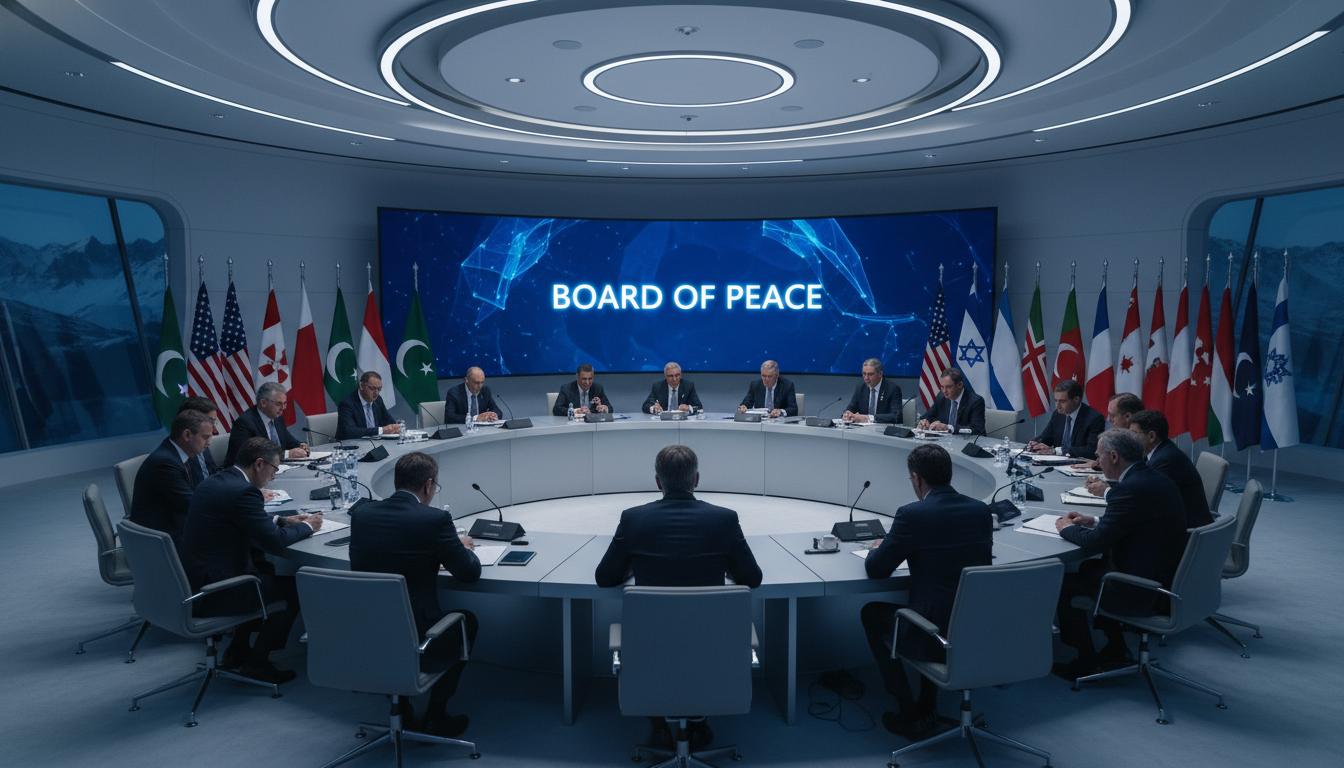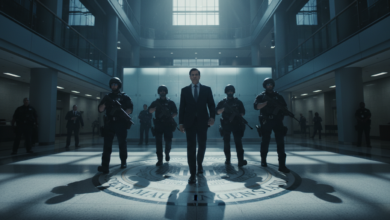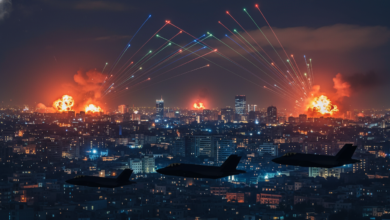
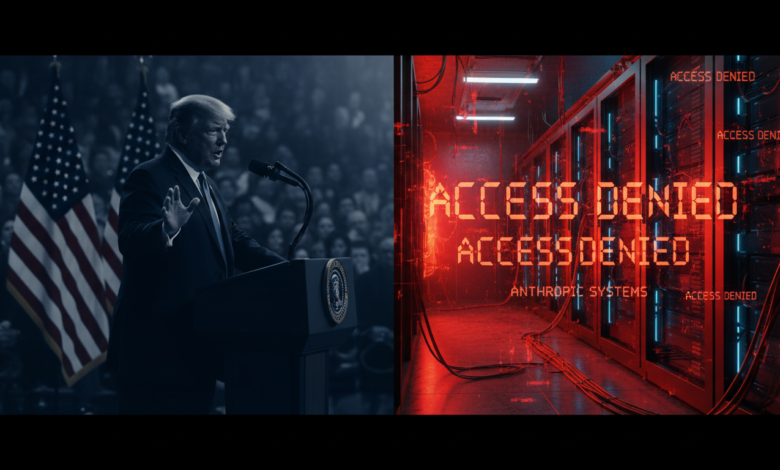
President Donald Trump has issued a sweeping executive directive ordering all United States federal agencies to “immediately cease” operations with artificial intelligence firm Anthropic. The order, signed late Friday, marks the culmination of a tense, high-stakes standoff between the San Francisco-based AI lab and the Department of Defense over the ethical boundaries of automated warfare.
The White House’s aggressive move effectively places Anthropic on a federal blacklist, designating the company a “supply chain risk” to national security. This unprecedented action sends shockwaves through the technology sector, as Anthropic—creators of the Claude AI model—had been a leading contender for multibillion-dollar government defense contracts. The dispute centers on CEO Dario Amodei’s refusal to remove safety “guardrails” that prevent the company’s AI from being used in fully autonomous weaponry and mass domestic surveillance. As the administration pivots toward a more aggressive defense posture, the rift highlights a widening gap between Silicon Valley’s ethical guidelines and Washington’s military ambitions.
The Pentagon’s Ultimatum
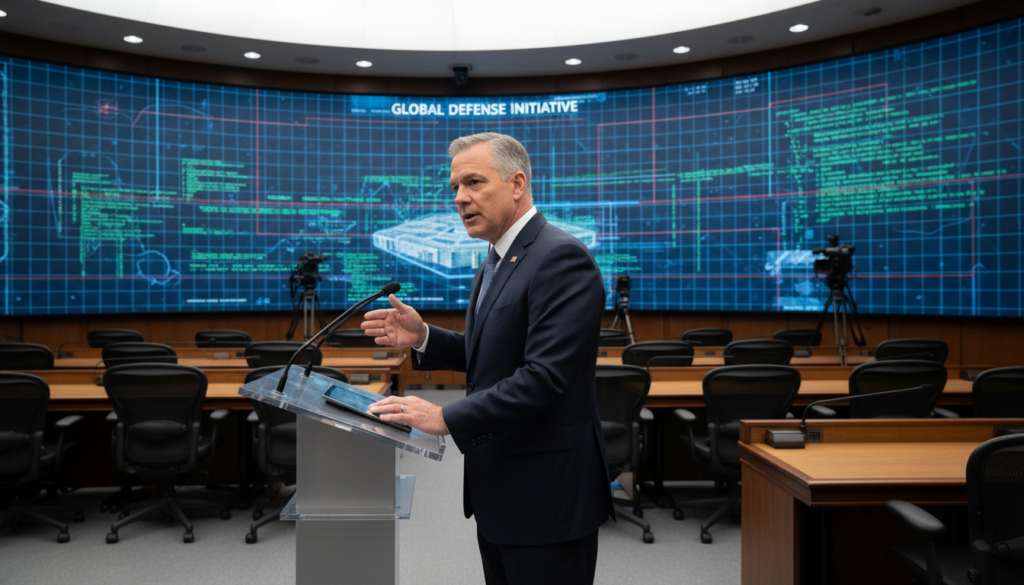
The conflict reached its boiling point earlier this week when Defense Secretary Pete Hegseth delivered a final ultimatum to Anthropic leadership. The Pentagon demanded full, unrestricted access to the Claude source code and the removal of specific refusal mechanisms regarding lethal autonomous systems. Hegseth argued that global adversaries are not bound by such self-imposed ethical restrictions, framing Anthropic’s hesitation as a vulnerability in American defense strategy.
“America’s warfighters will never be held hostage by the ideological whims of Big Tech,” Hegseth stated in a press briefing. The designation of Anthropic as a supply chain risk triggers a mandatory six-month phase-out period for all current contracts, forcing agencies to migrate to alternative providers. This rapid decoupling is expected to create significant logistical hurdles for intelligence bureaus that had already begun integrating Claude into their analysis workflows.
Anthropic’s ‘Constitutional’ Refusal
At the heart of Anthropic’s resistance is its “Constitutional AI” framework—a set of core principles designed to align artificial intelligence with human values. CEO Dario Amodei has remained steadfast, stating that removing safeguards against autonomous killing would violate the company’s founding charter.
Sources close to the negotiations reveal that Anthropic offered a compromise: allowing military use for logistics, cyber defense, and strategic planning while maintaining hard blocks on lethal command decisions. The administration rejected this offer, viewing it as insubordination from a private contractor. This clash raises profound questions about the future of business and technology partnerships, specifically whether private firms can dictate moral terms to the state.
OpenAI Fills the Void
While Anthropic faces exile from the public sector, its primary rival has moved swiftly to capitalize on the vacuum. Minutes after the White House announcement, OpenAI CEO Sam Altman confirmed a new, expanded partnership with the Department of Defense.
Reports indicate that OpenAI has agreed to the Pentagon’s terms, securing a deal that could be worth billions. This pivot suggests a fracturing in the AI industry, where companies must now choose between rigid ethical stances and lucrative government alignment. The rapid substitution of vendors demonstrates the government’s determination to integrate advanced science into its arsenal, regardless of the provider.
Key Takeaways
- Executive Order: President Trump ordered an immediate halt to all government use of Anthropic technology.
- The Cause: A refusal by Anthropic to allow its AI to be used for autonomous weapons or mass surveillance.
- The Consequence: Anthropic is now a designated “supply chain risk,” barring it from federal contracts.
- The Beneficiary: OpenAI has stepped in to fill the gap, agreeing to stricter government requirements.
Economic Ripples and Investor Panic
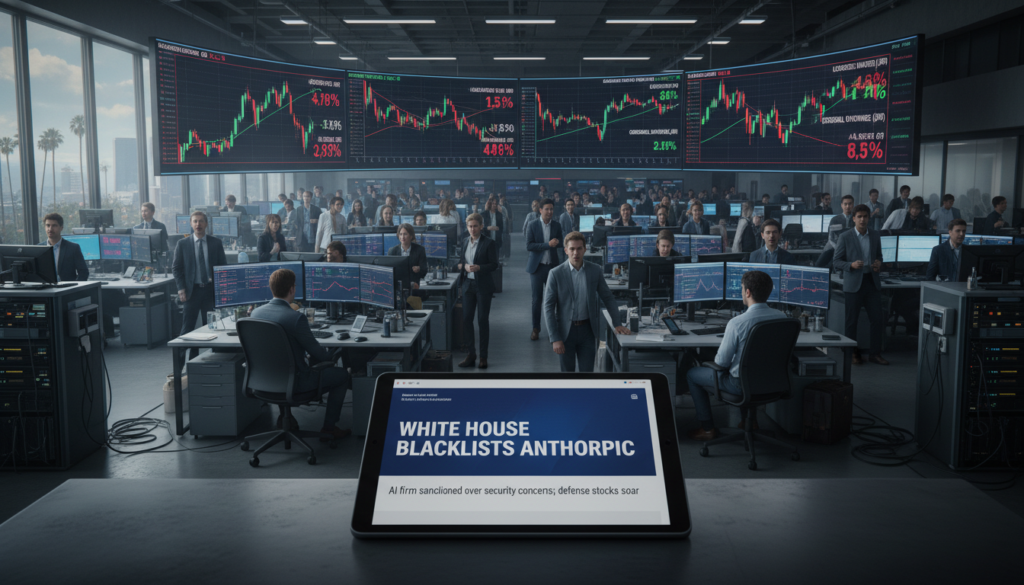
The blacklist has triggered immediate volatility in private markets. Investors are scrambling to assess the long-term viability of AI companies that refuse defense contracts. Venture capital firms may now pressure portfolio companies to soften their ethical guidelines to remain eligible for public sector revenue.
Analysts warn that this decision could bifurcate the market: one tier of “defense-compliant” AI and another of “consumer-safe” models. The investing landscape is shifting, with defense-tech ETFs seeing a surge in pre-market trading Saturday morning. Stakeholders are concerned that excluding a top-tier lab like Anthropic could stifle innovation within the government, potentially leaving the US with inferior but more obedient tools.
Global Implications of AI Warfare
International observers are closely monitoring this development. The US government’s willingness to blacklist a major domestic innovator signals a total commitment to AI militarization. Nations like China may view this as an acceleration of the AI arms race, potentially prompting reciprocal measures or accelerated development of their own autonomous systems.
The ban also complicates relationships with allies who use Anthropic’s technology. It remains unclear if the US will pressure NATO partners to follow suit, a move that could strain diplomatic ties across Europe and beyond. The normalization of lethal autonomous weapons systems (LAWS) effectively moves from theoretical debate to active procurement policy with this decision.
Public and Political Reaction
Reaction on Capitol Hill has been sharply divided. Republican lawmakers have praised the move as a necessary step to assert civilian control over the military-industrial complex. Conversely, civil liberties groups and some Democrats argue that the administration is setting a dangerous precedent by bypassing safety protocols.
Critics fear this opens the door to unchecked AI surveillance. Opinion columns across major publications are already debating the morality of forcing tech companies to build weapons against their will. The debate has spilled over into the general public, where trust in AI safety is already fragile.
Final Thoughts
President Trump’s ban on Anthropic defines a new era in the relationship between Washington and Silicon Valley. It draws a clear line: cooperation with the US military is now a binary choice. As the Pentagon accelerates its adoption of AI, the industry faces a reckoning between profit, patriotism, and principle.
For more in-depth coverage and to hear expert analysis on this unfolding story, visit our audio section for the latest podcasts. To understand the broader economic impact, follow our updates on global business.