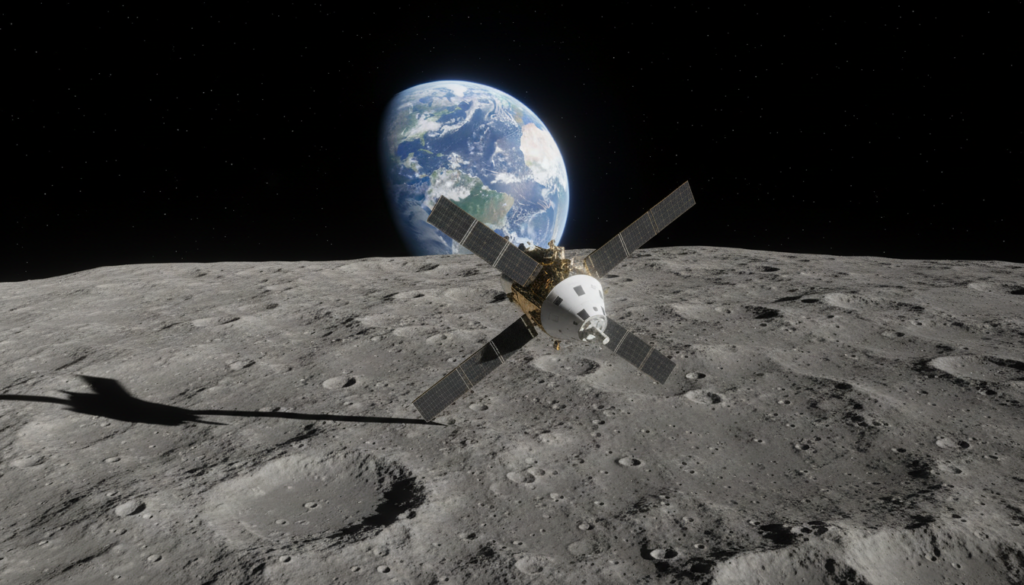
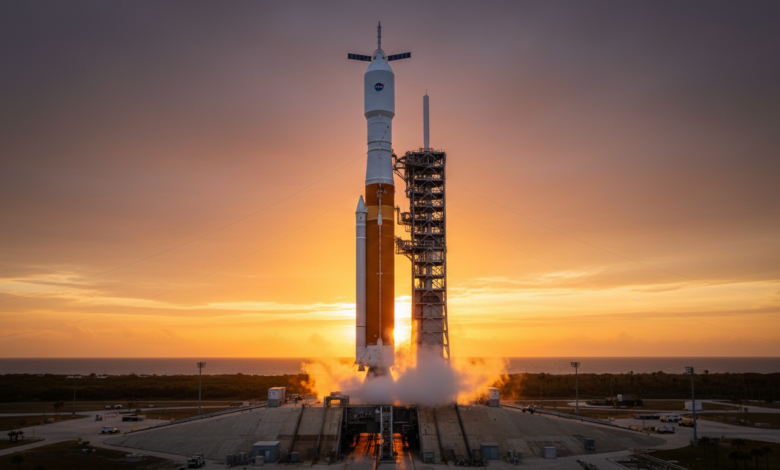
The countdown to the Artemis II launch has officially entered its final and most intense phase. With the calendar reading mid-February 2026, we are less than three weeks away from witnessing humanity’s return to lunar proximity. Scheduled for March 6, 2026, this mission marks the first time in over 50 years that astronauts will venture beyond low-Earth orbit. The atmosphere at NASA’s Kennedy Space Center in Florida is electric, with engineers and mission controllers working around the clock to ensure every system on the Space Launch System (SLS) rocket and the Orion spacecraft is flawless.
Global media attention has converged on the Space Coast, anticipating a spectacle that surpasses even the uncrewed Artemis I test. This is no longer a dress rehearsal; four lives are strapped into the capsule, ready to undertake a ten-day journey around the moon and back. As the world waits, the intersection of cutting-edge science and human bravery takes center stage.
The Countdown Begins: Final Checks at Kennedy Space Center
Operations at Launch Complex 39B are proceeding with surgical precision. Ground systems teams are currently conducting final closeout inspections of the mobile launcher and the massive SLS rocket. The Artemis II launch depends heavily on these last-minute verifications, ensuring that the propellant loading systems, avionics, and communication arrays are synchronized.
NASA has confirmed that the Flight Readiness Review is imminent. This critical milestone will formally greenlight the March 6 target. Security around the Americas region of the launch site has tightened, accommodating the influx of dignitaries and international press. The physical rollout of the vehicle was a sight to behold, but the digital checks happening now are what truly dictate success.
Engineers are paying special attention to the heat shield modifications implemented after Artemis I. Data from that previous flight revealed charring patterns that needed correction. NASA officials state that the new ablatant material application is robust, ready to withstand temperatures exceeding 5,000 degrees Fahrenheit upon reentry. For more on the agency’s official updates, you can check the NASA Artemis blog.
Meet the Crew: The Four Astronauts Making History
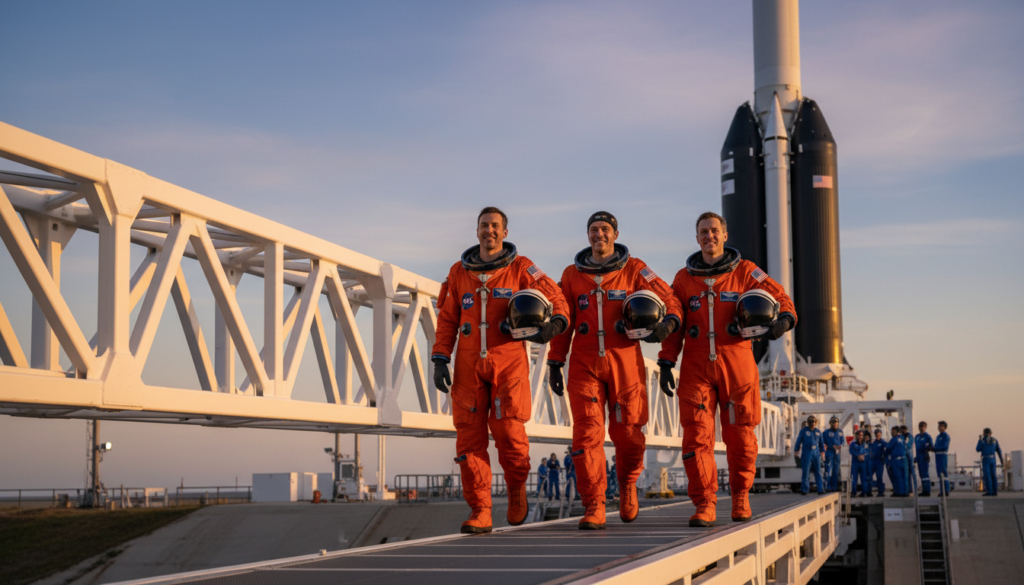
While the hardware is impressive, the heart of the mission lies with the crew. Commander Reid Wiseman, Pilot Victor Glover, Mission Specialist Christina Koch, and Mission Specialist Jeremy Hansen (CSA) have completed their quarantine protocols. Their training in the final weeks focuses on mission timeline simulations and emergency egress drills.
This diverse team represents a significant shift from the Apollo era, symbolizing a more inclusive approach to exploration that has captured attention across the world. Victor Glover will be the first person of color to leave low-Earth orbit, while Christina Koch becomes the first woman to do so. Jeremy Hansen marks Canada’s entry into deep space exploration.
Their schedule right now is regimented. They are reviewing flight plans, conducting physical conditioning, and spending final moments with families before isolation tightens. The psychological readiness of the crew is just as vital as the physical. We see this human element resonating deeply, influencing how style and culture engage with the space age, from the design of their suits to the mission patches they wear.
Tech Upgrades and Safety Protocols
The Artemis II launch showcases significant leaps in aerospace technology. Unlike the Apollo missions, Artemis relies on a digital backbone that allows for greater autonomy and data processing. The Orion capsule comes equipped with advanced life support systems that are being tested for the first time with humans on board.
Recent innovations in business tech have allowed for lighter, more durable materials in the crew module. These upgrades provide better radiation protection, a necessary feature for passing through the Van Allen belts. Contractors like Lockheed Martin and Boeing have worked alongside NASA to integrate these systems, a collaboration that highlights the robust state of investing in the aerospace sector.
Safety remains the paramount concern. The launch abort system (LAS) is armed and ready. This system can pull the crew capsule away from the rocket in milliseconds if a catastrophic failure occurs during ascent. Such redundancy is standard for modern human spaceflight, ensuring that the risks are calculated and mitigated.
Weather and Logistics: The March 6 Window
One variable remains outside human control: the weather. The March 6 launch window opens early in the morning, offering optimal orbital mechanics for the translunar injection burn. Meteorologists are closely monitoring patterns in the Atlantic, looking for clear skies and low wind shear.
Current forecasts from weather experts suggest a 70% chance of favorable conditions, though this can change rapidly in Florida’s dynamic climate. High-altitude winds are also a factor; even if the ground is clear, turbulence in the upper atmosphere can scrub a launch.
Logistically, the area surrounding Cape Canaveral is preparing for record-breaking crowds. Hotels are booked solid, and local authorities are implementing traffic patterns to handle hundreds of thousands of spectators. This surge is a boon for travel destinations along the coast, as space tourism proves to be a massive economic driver.
Monitoring the Environment
Beyond the immediate weather, the mission has a broader environmental mandate. Part of Artemis II’s goal is to capture high-resolution images of Earth, contributing to our understanding of climate change from a vantage point only a few dozen humans have ever seen. Seeing our planet as a fragile blue marble in the void often shifts perspectives on environmental stewardship.
What This Means for Future Exploration
Success on March 6 paves the way for Artemis III, which intends to land boots on the lunar surface. This mission is the proof of concept for sustained deep space operations. It validates the architecture that will eventually support the Lunar Gateway and future missions to Mars.
The political will behind this program remains strong, with bipartisan support evident in recent budget approvals discussed in politics. The Artemis Accords continue to grow, binding nations together in peaceful space exploration. For a deeper dive into the geopolitical implications, Reuters provides excellent analysis on international space relations.
Final Thoughts
As we approach the Artemis II launch, the excitement is palpable. It represents a triumph of engineering, international cooperation, and the enduring human spirit of exploration. Whether you are watching for the technological marvels or the historic human milestones, March 6, 2026, promises to be a day etched in history. For those following the financial side of this massive undertaking, the impact on the space economy is detailed in business media reports.
Stay tuned as we continue to track the progress of Wiseman, Glover, Koch, and Hansen. The moon awaits.