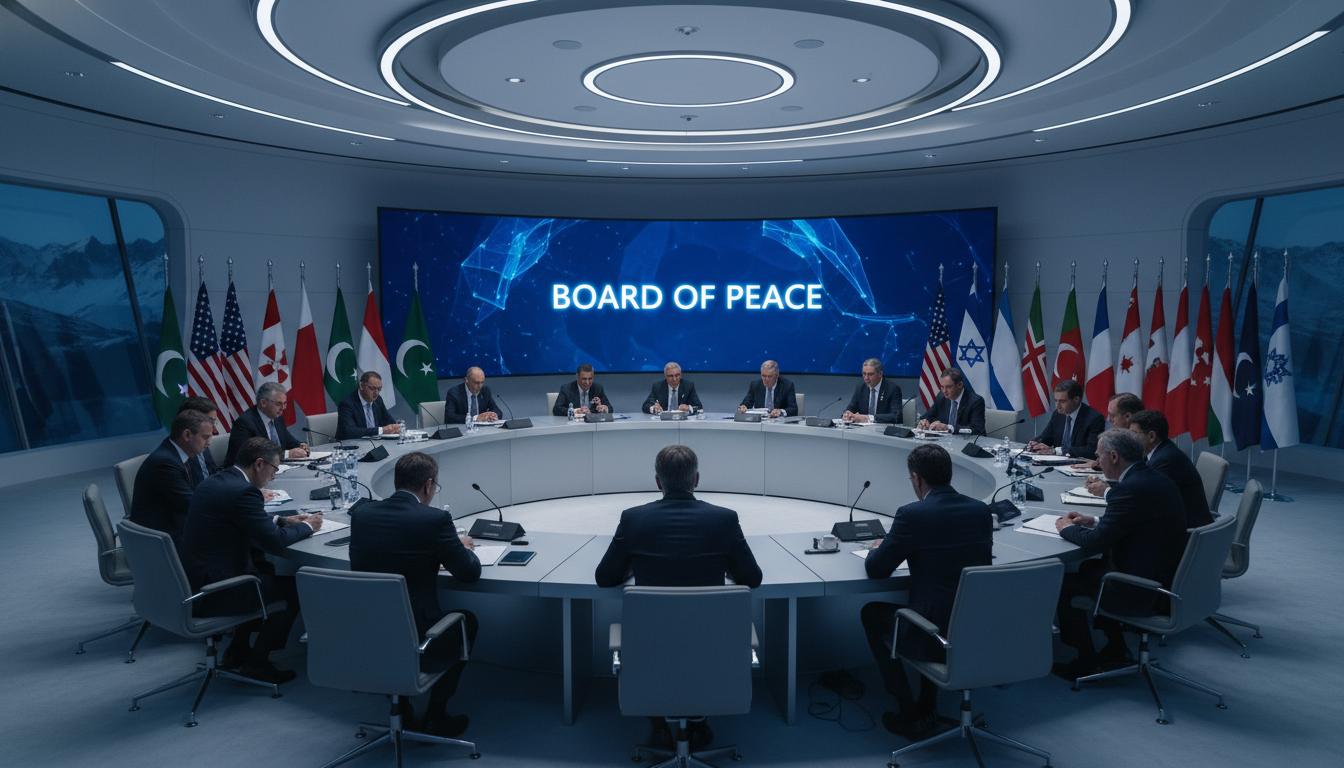
The Board of Peace: A Paradigm Shift in Global Governance and Conflict Resolution
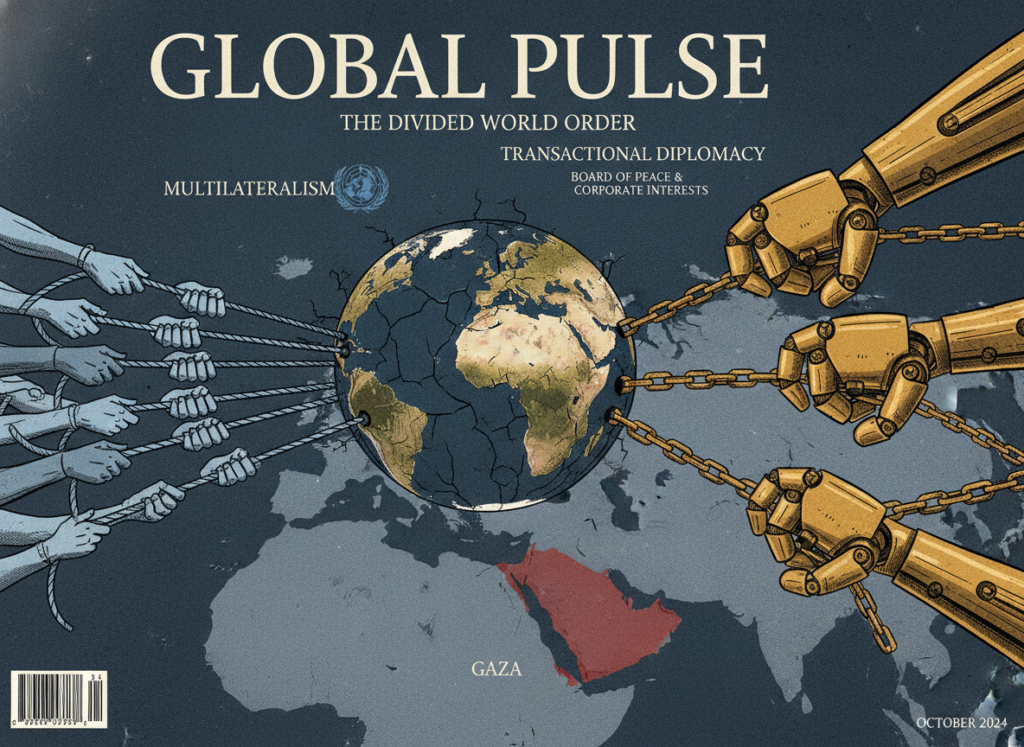
The establishment of the Board of Peace in early 2026 marks one of the most significant—and controversial—developments in modern international relations. Ostensibly created to oversee the reconstruction of the Gaza Strip following the ceasefire of 2025, the body has rapidly evolved into a global entity that challenges the hegemony of the United Nations. For students and scholars of political science, the Board represents a critical case study in the shift from multilateral institutionalism to transactional diplomacy.
This article provides an academic analysis of the Board of Peace, examining its origins, its highly centralized governance structure, and the profound questions it raises regarding legitimacy, sovereignty, and the future of the liberal international order.
The Origins and Mandate: From Gaza to the Globe
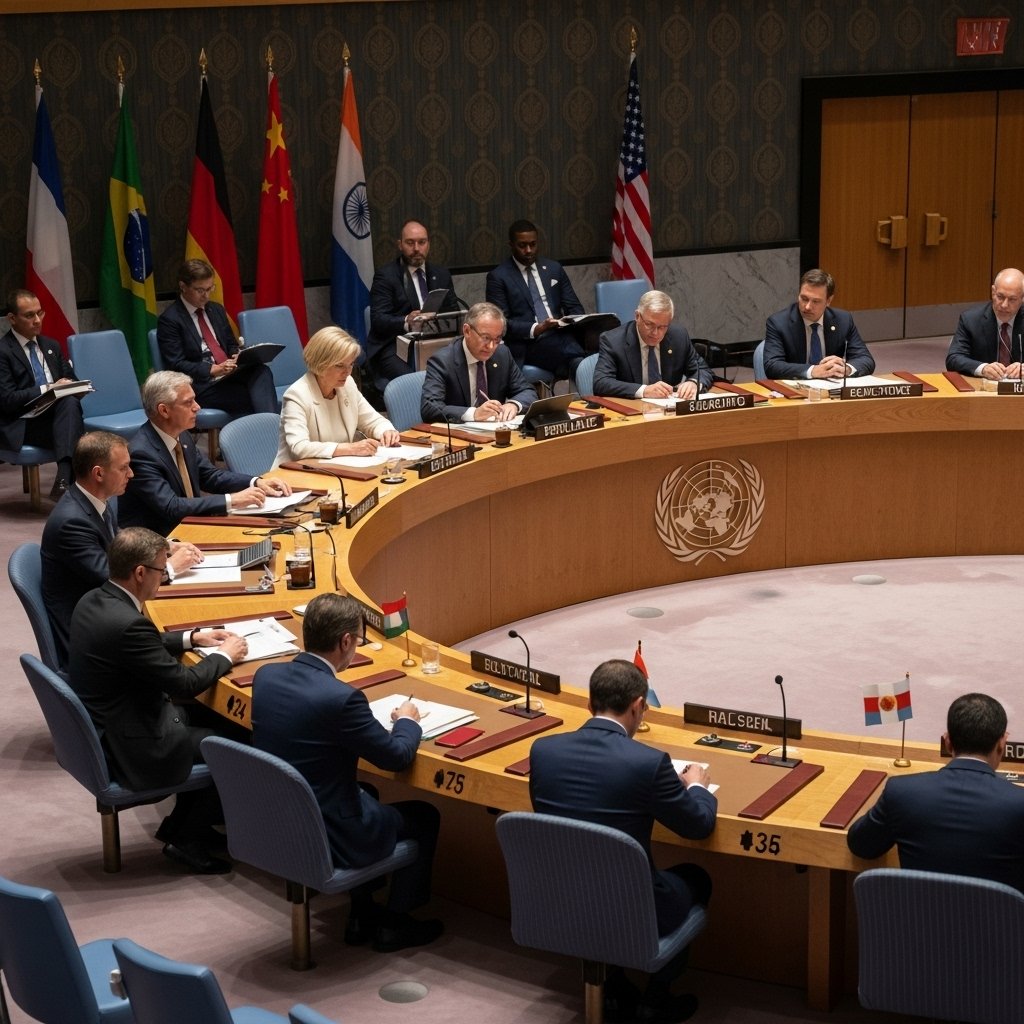
The Board of Peace was initially conceived as the centerpiece of the “20-Point Plan” introduced by U.S. leadership to address the crisis in Gaza. Its foundational legitimacy was anchored in United Nations Security Council Resolution 2803, passed in November 2025, which authorized the body to function as a transitional administrative authority. The original mandate was technically specific: to coordinate disarmament, manage the International Stabilization Force (ISF), and oversee the disbursement of reconstruction funds.
However, the official launch at the World Economic Forum in Davos revealed a charter with far broader ambitions. Unlike traditional peacekeeping missions which are geographically bound and temporally limited, the Board of Peace has asserted a global remit. Its charter declares an intent to “promote stability and restore dependable governance” in any region threatened by conflict, effectively positioning it as a parallel competitor to the UN Security Council.
Structural Realism vs. Institutionalism
From a theoretical perspective, the Board’s creation can be viewed through the lens of Structural Realism. It represents a move by a hegemon to bypass established institutions that are perceived as constrained by bureaucracy or opposing veto players (such as Russia or China within the UN system). By creating a new institution where membership is by invitation and leadership is centralized, the U.S. administration is attempting to reconstruct the international architecture to better favor its own strategic flexibility.
The Controversy of Governance and Membership
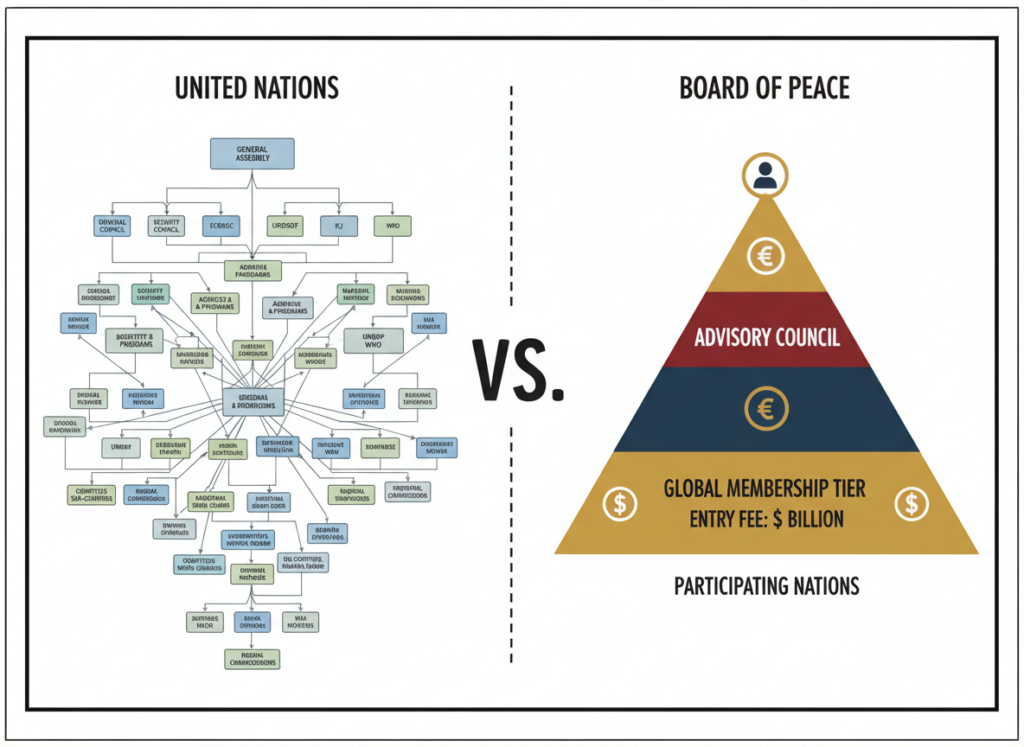
The most distinct feature of the Board of Peace—and the source of intense academic criticism—is its governance structure. Unlike the egalitarian “one state, one vote” principle of the UN General Assembly, or the permanent-member veto system of the Security Council, the Board operates on a model that critics describe as “corporate sovereignty.”
The “Chairman for Life” and Centralized Power
The Board’s charter designates the U.S. President as the inaugural Chairman, a position that notably does not expire with his presidential term. This “Chairman for Life” clause grants the holder extraordinary powers, including the exclusive right to appoint executive board members, veto majority decisions, and even handpick a successor. This centralization of power is unprecedented in public international law, resembling a private board of directors more than an intergovernmental organization.
Financial Barriers and the “Pay-to-Play” Model
Perhaps the most contentious aspect is the financial requirement for permanent membership. Reports indicate a threshold of $1 billion in direct funding is required to secure a permanent seat. This has led to accusations of a “pay-to-play” system that privileges wealthy nations and private economic interests over diplomatic legitimacy.
Founding members currently include a diverse coalition such as Saudi Arabia, Pakistan, Egypt, Israel, and Hungary. Notably absent are traditional Western allies like the United Kingdom, Canada, and France, who have publicly expressed concerns over the Board’s compatibility with international law and democratic values. This fissure highlights a deepening transatlantic divide and suggests a realignment of global alliances based on transactional interests rather than shared ideology.
Implications for International Relations Theory
The existence of the Board of Peace forces a re-evaluation of several core concepts in International Relations (IR) theory.
1. The Erosion of Multilateralism
Since 1945, global governance has been defined by multilateralism—the idea that international rules should be binding on all states and determined through collective deliberation. The Board of Peace represents a shift toward minilateralism or selective cooperation, where a small group of actors makes decisions that affect the wider system, bypassing universal bodies like the UN.
2. The Privatization of Peacebuilding
The heavy involvement of private sector figures and the corporate-style governance of the Board suggest a trend toward the privatization of diplomatic functions. By prioritizing “stability” and “economic reconstruction” over political rights or justice—a critique leveled by organizations like The Brookings Institution—the Board reframes peace as a technical, economic project rather than a political one. This approach mirrors the “market-washing” of conflict resolution, where profitability and resource mobilization take precedence over self-determination.
3. Legitimacy vs. Effectiveness
A central debate in political science concerns the trade-off between input legitimacy (who gets to decide) and output legitimacy (the effectiveness of the results). Proponents of the Board argue that the UN has failed in its duty to maintain peace due to gridlock, and that a streamlined, CEO-style executive can deliver tangible results—such as rapid reconstruction in Gaza—more effectively. Critics counter that without broad-based input legitimacy and the consent of the governed (specifically the Palestinian population, who are notably absent from the Board’s leadership), any “peace” achieved will be inherently unstable and viewed as an imposition.
The Board of Peace and Regional Dynamics
The Board’s impact is already reshaping the Middle East. By securing the participation of key regional players like Saudi Arabia, Turkey, and Egypt, the Board has created a new diplomatic forum that excludes Iran and sidelines the Palestinian Authority. This alignment serves to consolidate a U.S.-backed security architecture in the region, independent of the gridlocked UN Security Council.
However, the exclusion of rival powers creates risks. Russia and China have predictably denounced the Board as a tool of Western imperialism. Their exclusion, coupled with the Board’s expansive mandate, raises the specter of fragmented global governance, where rival blocs operate their own “peace” mechanisms, leading to a breakdown in universal international law.
A Dangerous Experiment?
The Board of Peace is more than just a new organization; it is a symptom of a fracturing global order. It challenges the definition of an international organization by blending public authority with private governance models.
For political scientists, the Board serves as a real-time experiment in whether transactional, authoritarian-style governance can succeed where liberal multilateralism has struggled. Whether it succeeds in rebuilding Gaza or collapses under the weight of its own legitimacy crisis, the Board of Peace has undeniably altered the landscape of international relations.