
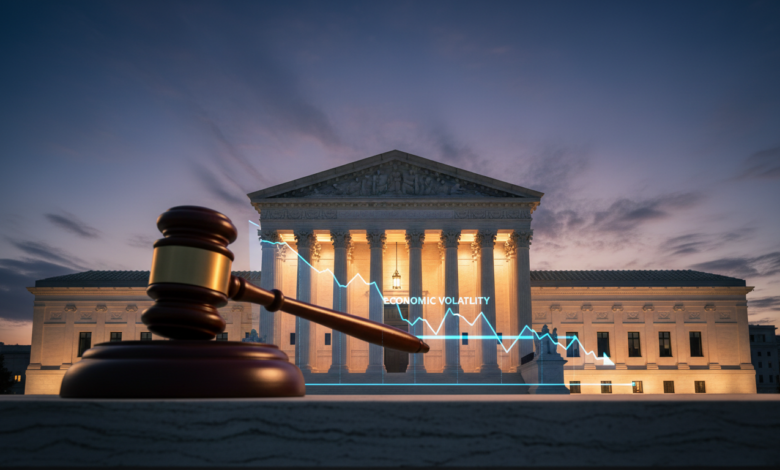
In a historic and seismic legal shift, the United States Supreme Court has struck down President Trump’s sweeping tariffs, declaring the administration’s use of the International Emergency Economic Powers Act (IEEPA) to impose levies as an illegal expansion of executive power. This Supreme Court tariff ruling, delivered on February 20, 2026, fundamentally alters the separation of powers regarding trade policy and has sent shockwaves through the global economy.
Justices ruled 6-3 that while the President holds significant authority during national emergencies, the broad application of IEEPA to enact permanent tariff structures bypasses Congressional authority to regulate commerce. The decision immediately voids the 25% universal tariffs implemented earlier this year, creating a chaotic environment for importers, exporters, and investors alike.
Following the announcement of this landmark Supreme Court decision, Wall Street saw immediate turbulence. Traders are scrambling to re-price assets that were previously hedged against a high-tariff regime. The legal outcome restores Congressional oversight but introduces significant uncertainty regarding the future of US trade protectionism.
The Legal Basis: Limiting the IEEPA
The core of the Supreme Court tariff ruling centers on the interpretation of the IEEPA. Historically, Presidents have used this act to sanction specific bad actors or hostile nations. However, the Trump administration utilized it to apply blanket tariffs on allies and adversaries alike, citing economic security as a national emergency.
Chief Justice Roberts, writing for the majority, stated that equating general economic competition with an “unusual and extraordinary threat” grants the Executive Branch unlimited legislative power, which violates the Constitution. This interpretation restricts future administrations from bypassing Congress for broad economic policy changes.

Legal scholars suggest this is the most significant check on presidential economic authority in decades. For a deeper understanding of the statute, you can review the official legislative text governing emergency powers.
Stock Market Volatility and Investor Reaction
The financial response was instantaneous. Major indices fluctuated wildly as algorithms and institutional investors digested the news. The market volatility observed today reflects a sudden repricing of risk. Sectors that benefited from protectionism, such as domestic steel and manufacturing, saw sharp declines, while import-heavy retail stocks rallied.
Uncertainty remains the dominant theme. While the removal of tariffs lowers costs for many businesses, the political instability suggests a contentious path forward. Investors monitoring global exchanges are now looking for signs of how the administration will pivot.
Impact on Tech and Manufacturing
Technology companies, heavily reliant on global supply chains, are among the biggest beneficiaries of the ruling. The previous tariff regime threatened to inflate costs for hardware components. With the levies voided, companies like NVIDIA are seeing renewed interest, contributing to the ongoing AI market rally.
Conversely, domestic manufacturers who ramped up production based on tariff protection now face renewed foreign competition. This pivot could lead to short-term disruptions in the labor market as factories adjust to the new reality.

Global Trade Relations and Supply Chains
International allies have welcomed the Supreme Court tariff ruling, viewing it as a return to a rules-based order. The European Union and key Asian partners had threatened retaliatory measures, which are now likely suspended. This de-escalation acts as a stabilizer for the broader economic landscape.
However, supply chains remain fragile. The sudden policy reversal requires logistics networks to pivot yet again. Recent efforts to strengthen supply chain security between India and the US highlight the ongoing strategic shift away from total reliance on China, regardless of tariff levels.
According to a report by Reuters, trade volumes at major US ports are expected to surge as importers rush to bring in goods without the added tax burden, potentially straining infrastructure.
Inflation and Economic Data
One of the primary arguments against the tariffs was their inflationary impact. With the tariffs removed, economists expect a moderation in price increases for consumer goods. This comes at a pivotal moment, as recent data indicated inflationary pressures were beginning to mount again in late 2025 and early 2026.
The Federal Reserve will likely view this ruling as a deflationary event. This could influence the Federal Reserve strategy moving forward, potentially allowing for a more dovish stance on interest rates if price stability is achieved faster than anticipated.

However, the immediate disruption might briefly impact GDP growth projections for the first quarter as businesses pause capital expenditure to reassess their strategies.
What This Means for Your Portfolio
For the average investor, this legal earthquake underscores the importance of diversification. The investment portfolios heavily weighted toward protected industries may suffer, while diversified global funds could see gains.
Financial advisors recommend staying the course rather than panic selling. Volatility is high, but the fundamental removal of tax barriers is generally viewed as positive for corporate earnings in the long run. Monitoring Bloomberg for real-time analysis on sector rotation is advisable during this transition period.
Final Thoughts
The Supreme Court tariff ruling of 2026 is a defining moment for US trade policy. By curbing the use of the IEEPA, the Court has reasserted Congressional dominance over commerce, ending a period of unilateral executive protectionism.
While the immediate aftermath involves market confusion and political fallout, the long-term result may be a more stable, albeit competitive, global trading environment. Businesses and consumers alike must now navigate a landscape where trade barriers can no longer be erected by a single signature.