The Imperative for Structural Change in Global Governance
The United Nations Security Council (UNSC) stands as the premier organ of international crisis management. Established in the aftermath of World War II, its primary mandate is the maintenance of international peace and security. However, as we navigate the third decade of the 21st century, a growing consensus suggests that the Council’s structure is anachronistic, reflecting the geopolitical realities of 1945 rather than the multipolar world of today. UN Security Council reform has moved from a theoretical debate to an urgent diplomatic necessity.
Critics argue that without significant structural changes, the UNSC risks losing its legitimacy and effectiveness. The exclusion of major emerging powers and entire continents from permanent membership creates a representational deficit that undermines the Council’s authority. This article delves into the history, the contenders for new seats, the controversy regarding the veto power, and the complex path toward achieving meaningful reform.
The Current Architecture and Its Flaws
To understand the push for reform, one must first analyze the status quo. The Council consists of 15 members: five permanent members (the P5) and ten non-permanent members elected for two-year terms. The P5—China, France, the Russian Federation, the United Kingdom, and the United States—possess the power of veto, enabling any single one of them to block substantive resolutions.
The Representation Deficit
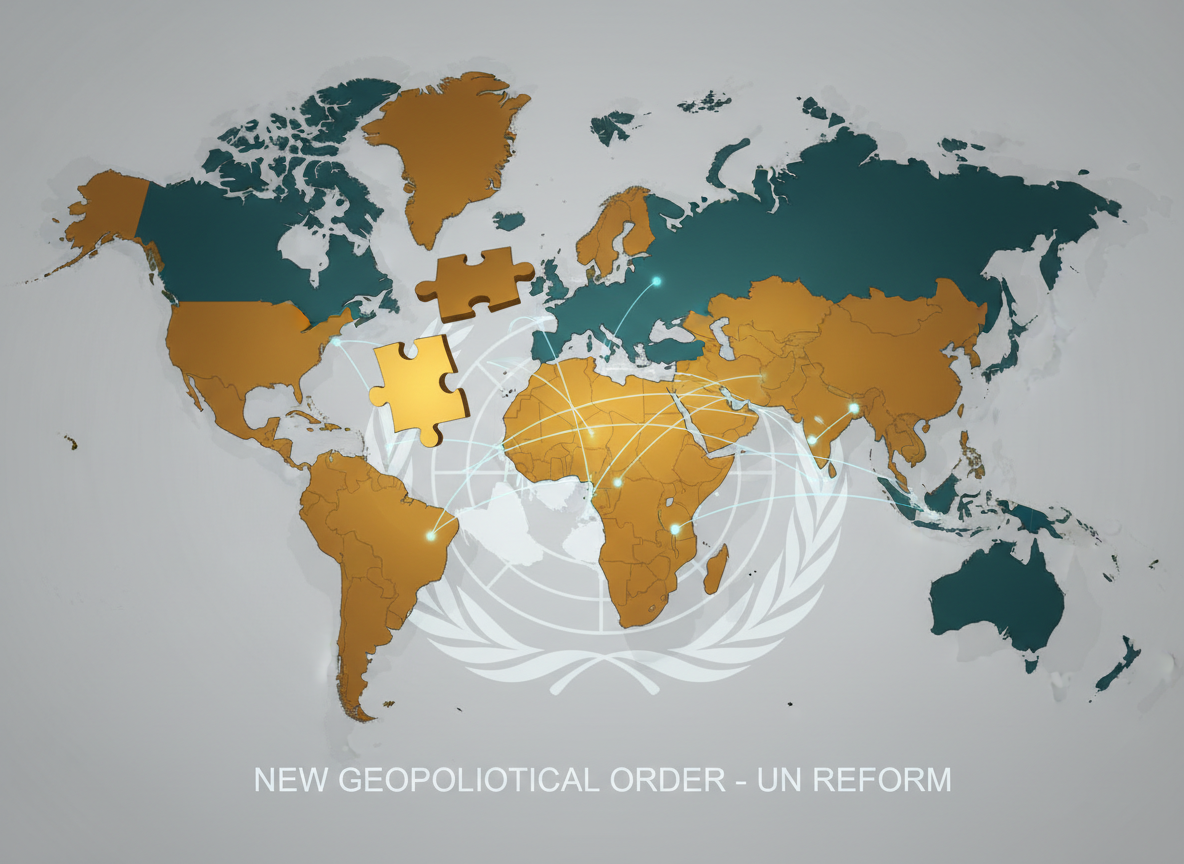
The primary driver for UN Security Council reform is the issue of equitable representation. Europe is currently over-represented in the permanent category, while Africa, Latin America, and the Caribbean have no permanent seats. This imbalance ignores the rise of the Global South and the economic and demographic shifts that have occurred over the last 75 years.
The Veto Problem
The veto power is perhaps the most contentious aspect of the UNSC. Originally designed to keep the great powers at the table, it is now frequently criticized for paralyzing the Council during humanitarian crises. Whether it is the conflict in Syria, Ukraine, or Gaza, the veto has often prevented the UN from taking decisive action, leading to calls for its restriction or total abolition.
Key Proposals and Contenders: The G4 and The African Union
Several blocs have emerged with specific proposals for expanding the Council. The most prominent among them is the Group of Four (G4), comprising Brazil, Germany, India, and Japan.
The G4 Nations
The G4 nations support each other’s bids for permanent seats on the UNSC. Their argument is based on their significant contributions to the UN budget, participation in peacekeeping missions, and their influence on the global economy.
- India: As the world’s most populous nation and a nuclear power with a rapidly growing economy, India argues that its exclusion is a denial of current geopolitical realities.
- Japan and Germany: As two of the largest financial contributors to the UN, these nations argue that economic influence should correlate with decision-making power.
- Brazil: Brazil seeks to represent Latin America, arguing that the region deserves a permanent voice at the horseshoe table.
The Ezulwini Consensus
The African Union (AU) has taken a unified stance known as the Ezulwini Consensus. This proposal demands two permanent seats and five non-permanent seats for Africa. Crucially, the AU insists that new permanent members must possess the same prerogatives as current members, including the right of veto—though they have indicated a willingness to forgo exercising it until the veto is abolished entirely.
The Opposition: Uniting for Consensus
Countering the G4 is the “Uniting for Consensus” (UfC) group, nicknamed the “Coffee Club.” Led by nations such as Italy, Pakistan, South Korea, Argentina, and Mexico, this group opposes the expansion of permanent seats. Their primary argument is that adding more permanent members would create new centers of privilege and further reduce the accountability of the Council to the wider General Assembly.
Instead, the UfC proposes increasing the number of non-permanent seats and creating a new category of longer-term renewable seats. They argue this approach makes the Council more democratic and flexible, preventing a new hierarchy from becoming entrenched.
The Hurdles to Amendment
Achieving UN Security Council reform is legally and politically difficult due to the requirements of the UN Charter. Article 108 of the Charter stipulates that any amendment requires a two-thirds vote in the General Assembly and ratification by two-thirds of the members, including all five permanent members of the Security Council.
This creates a “Catch-22” scenario. The P5 are unlikely to ratify any amendment that dilutes their own power. Specifically, the extension of veto power to new members is a non-starter for the current P5. Furthermore, regional rivalries—such as China opposing Japan, or Pakistan opposing India—complicate the consensus required for a General Assembly vote.
Recent Developments and Future Outlook
Despite the deadlock, momentum has been building. The United States has recently signaled more explicit support for expanding the Council to include permanent representation for Africa and Latin America/the Caribbean. General Assembly President sessions regularly feature UN Security Council reform as a top agenda item, with the “Intergovernmental Negotiations” (IGN) framework serving as the forum for debate.
The Summit of the Future
Looking ahead, the UN’s “Summit of the Future” is viewed by many diplomats as a critical juncture. It offers a platform to reset the multilateral system. However, without a willingness to compromise on the issue of the veto, structural changes remain elusive.
The debate over UN Security Council reform is a battle between the legacy of the past and the demands of the future. While the G4, the African Union, and other reformist groups have compelling arguments, the rigid amendment process and the self-interest of the P5 present formidable obstacles.
However, the cost of inaction is high. A Security Council that fails to represent the world it governs will eventually lose the moral authority required to enforce international law. For the UN to remain the cornerstone of global peace, reform is not just an option; it is an existential imperative.