
A stunning case of friendly fire over the Texas border has ignited a firestorm in Washington. On Thursday, the US military deployed a high-energy laser weapon to shoot down a surveillance drone near Fort Hancock, Texas, under the belief it was a threatening intruder. It was later confirmed that the aircraft actually belonged to US Customs and Border Protection (CBP). The incident has forced the Federal Aviation Administration (FAA) to abruptly close airspace in the region, disrupting travel and fueling accusations of dangerous incompetence among federal agencies.
This marks the second major airspace conflict in the region in less than a month, following a similar event where a laser was used against a party balloon mistaken for a cartel device. Lawmakers are now demanding answers, calling the lack of coordination between the Pentagon—referred to by the current administration as the “Department of War”—and the Department of Homeland Security a critical failure that endangers public safety. With tensions already high along the southern border, this latest blunder has left officials scrambling to explain how two armed branches of the government could be so dangerously out of sync.
The Incident at Fort Hancock
According to a joint statement released late Thursday, the engagement occurred when military operators detected a “seemingly threatening unmanned aerial system” entering what they designated as military airspace. Acting under counter-unmanned aircraft system (C-UAS) authorities, the military engaged the target using a directed-energy weapon, reportedly the LOCUST laser system.

The drone was disabled and crashed near Fort Hancock, a small community roughly 50 miles southeast of El Paso. While no injuries were reported, the fallout was immediate. The FAA issued a Notice to Air Missions (NOTAM), shutting down airspace in the sector for “special security reasons.” This restriction is expected to remain in place until June, complicating operations for regional air traffic.
Sources indicate that the CBP drone was conducting routine surveillance operations but had not properly notified the military command of its flight path. This communication gap led military operators to treat the friendly aircraft as a hostile threat, likely suspecting it to be a cartel-operated drone.
Lawmakers: “Our Heads Are Exploding”
The reaction on Capitol Hill was swift and furious. Senior Democrats on the House Transportation and Infrastructure Committee expressed total disbelief at the breakdown in communication. Representatives Rick Larsen, André Carson, and Bennie Thompson issued a blistering statement, declaring that “our heads are exploding over the news.”
They argued that this incident was entirely preventable and pointed to a stalled bipartisan bill intended to standardize training for drone operators and improve inter-agency protocols. “Now, we’re seeing the result of its incompetence,” the lawmakers wrote, placing blame squarely on the administration’s disjointed management of border security assets.
The friction between the US politics sector and military leadership is palpable. Critics argue that the aggressive rules of engagement authorized by the “Department of War” prioritize speed over verification, creating a high-risk environment for both civil and government aviation.
A Pattern of “Chaos in the Skies”
This shoot-down is not an isolated event but part of a troubling pattern emerging in 2026. Just two weeks prior, the FAA was forced to ground flights at El Paso International Airport after CBP agents—using a borrowed military laser system—shot down what they claimed was a cartel drone. It was later identified as a metallic “Happy Valentine’s” balloon.
That earlier incident caused significant disruptions to business and travel in the region. The recurrence of such high-stakes errors suggests a systemic failure in how the airspace along the US-Mexico border is managed. The proliferation of high-tech laser weapons, intended to counter smuggling drones, has seemingly outpaced the safety protocols needed to operate them safely in domestic skies.
Local officials in El Paso are increasingly worried about the impact on the community. Frequent airspace closures threaten not only commercial aviation but also the region’s economic stability. Residents are left wondering if the skies above their homes have become a testing ground for experimental military engagement rules.
The “Department of War” Stance
The terminology used in official statements highlights the shift in tone under the current administration. The Pentagon, now frequently styled as the “Department of War,” defended the action as necessary to mitigate potential threats. Their stance is that the border is an active defense zone, and unauthorized aircraft are subject to immediate neutralization.
However, this aggressive posture clashes with the operational realities of domestic law enforcement. CNN Opinion contributors have noted that treating the border as a purely military theater ignores the complex web of civilian and federal agencies that must operate there simultaneously. The lack of a unified command structure for airspace management appears to be the root cause of these friendly fire incidents.
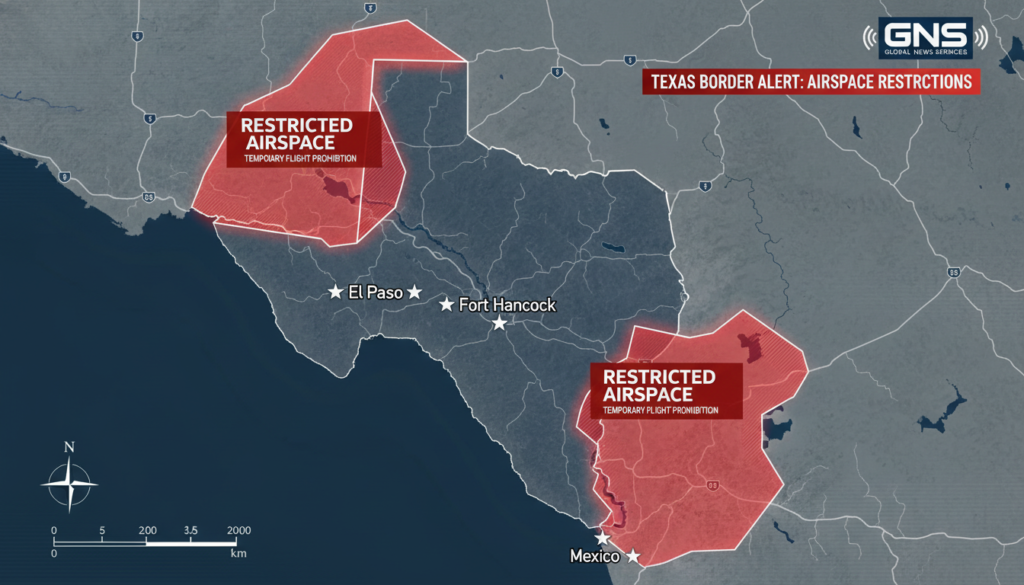
The FAA finds itself in the difficult position of managing the fallout. While they are responsible for civil aviation safety, their authority is being challenged by the military’s unilateral actions. The extended airspace closure over Fort Hancock serves as a stark reminder of who currently holds the upper hand in this inter-agency tug-of-war.
Technology Outpacing Policy
The use of directed-energy weapons like lasers represents a significant leap in counter-drone technology. These systems are silent, invisible, and cost-effective per shot. However, their use in domestic airspace raises profound legal and safety questions. CNN Tech analysts suggest that without digital “friend or foe” identification systems standard in military combat but lacking in domestic agency drones these accidents were inevitable.
The incident also touches on broader issues of government efficiency. While the US economy grapples with various challenges, the loss of expensive government hardware due to friendly fire is a waste of taxpayer money that is difficult to justify. The destroyed drone represents not just a security failure but a financial one.
Furthermore, the psychological impact on the public cannot be ignored. The normalization of shooting down aircraft over American soil, even unmanned ones, changes the character of life in border communities. It introduces a war-zone dynamic to daily life that many find unacceptable.
Key Takeaways
- Friendly Fire: The US military used a laser weapon to shoot down a CBP drone, mistaking it for a threat.
- Repeat Offense: This is the second such incident in February 2026, following a laser strike on a balloon.
- Political Fallout: Lawmakers are outraged, citing “incompetence” and a lack of coordination between the “Department of War” and DHS.
- Operational Impact: Airspace near Fort Hancock remains closed until June, disrupting regional travel.
What This Means for Border Security
Moving forward, this incident will likely force a high-level review of engagement protocols. The administration may be compelled to establish a joint command center to oversee all aerial operations along the border to prevent future mishaps. Until then, pilots and travelers in the region should expect continued uncertainty.
The safety of the national airspace system depends on the ability of federal agencies to talk to each other. As it stands, the silence between them is being broken by the sound of crashing drones.
For more on how technology is reshaping security, visit CNN Science. To understand the global implications of military policy, read more at CNN World. For updates on the travel impact, check CNN Travel Destinations.